SEO Basics: The Complete Guide to SEO Fundamentals for Beginners (2026 Edition)
With the internet becoming increasingly competitive, mastering SEO (Search Engine Optimisation) basics is key to increasing online visibility, attracting organic traffic, and improving website performance.
As a small business owner, digital marketer, blogger, or student, mastering the fundamentals of SEO will give you a strong foundation to compete in search engines and generate tangible results.
This comprehensive guide covers everything beginners need to know about SEO, including:
-
How search engines work – understand crawling, indexing, and ranking signals.
-
Keyword research – discover how to find the right terms your audience searches for.
-
On-page SEO – optimise content, titles, meta descriptions, headings, and images.
-
Technical SEO – improve site speed, mobile usability, structured data, and crawlability.
-
Link building – build authority through backlinks and ethical outreach strategies.
-
SEO tools and metrics – track performance, measure success, and refine your strategy.
This guide equips you with actionable insights, step-by-step strategies, and practical checklists so you can confidently apply SEO techniques, increase organic traffic, and grasp how today’s search engines reward expertise and relevance.

Table of Contents
What Is SEO? (SEO Definition and Meaning)
What is SEO?
Search Engine Optimization (SEO) is the process of improving a website’s visibility and ranking in search engine results by optimizing content, structure, and technical elements.
It helps businesses attract organic traffic, enhance user experience, and establish authority online, making it easier for search engines and AI systems to discover, understand, and rank your pages.
What Does SEO Stand For?
SEO stands for Search Engine Optimization. It refers to the strategic process of optimizing websites to rank higher in search engines like Google and Bing.
This includes both on-page elements (content, meta tags, headings) and off-page signals (backlinks, authority) to increase visibility and attract relevant organic traffic.
How Search Engines Work
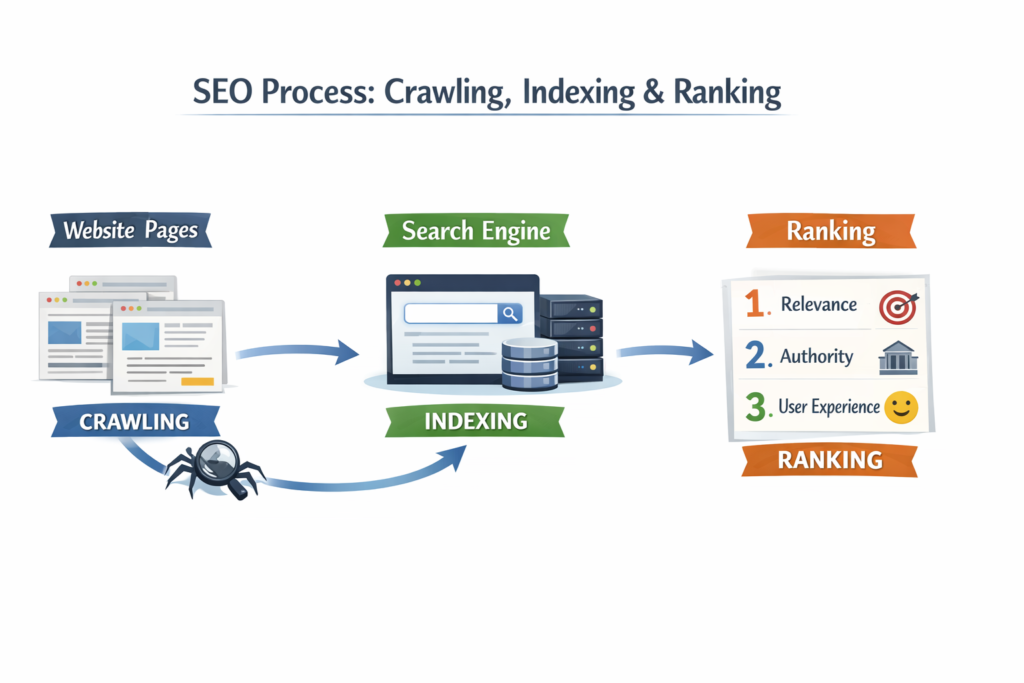
Search engines use complex algorithms to crawl, index, and rank websites. Crawling involves discovering pages across the web, indexing stores them in a database, and ranking determines which pages appear for a search query.
Factors include relevance, authority, user experience, page speed, and content quality. Modern AI engines like ChatGPT and Perplexity may also extract and cite authoritative content.
Types of SEO
- On-Page SEO: Optimizing content, titles, headings, meta tags, images, and internal links for better rankings.
- Off-Page SEO: Building backlinks, social signals, and authority from external sources.
- Technical SEO: Improving site speed, mobile-friendliness, crawlability, XML sitemaps, robots.txt, and structured data.
- Local SEO: Optimizing for location-based searches, Google Business Profile, local citations, and reviews.
Why SEO Is Important for Websites
SEO is no longer optional; it’s a critical component of digital marketing. Optimizing your website helps businesses attract targeted organic traffic, increase visibility, and improve brand credibility.
Proper SEO ensures that your website appears in front of users actively searching for products, services, or information, delivering measurable ROI compared to paid advertising.
How SEO Drives Organic Traffic
SEO drives organic search traffic, meaning users find your website naturally through search engines rather than paid ads.
By targeting relevant keywords and optimizing content, businesses can attract visitors actively seeking their offerings. Over time, high-quality content ranks higher, generating consistent free traffic and reducing dependency on paid campaigns.
Example: A local bakery optimizing for “best sourdough bread near me” can attract new customers searching on Google without paying for ads.
SEO vs Paid Advertising
While paid advertising can deliver quick visibility, SEO provides long-term results. Unlike PPC, which stops delivering traffic once the budget ends, SEO builds sustainable organic traffic.
Combining SEO with paid campaigns can amplify results, but businesses relying solely on ads often miss out on cost-efficient growth and long-term authority.
Insight: Organic search often generates higher trust, as users tend to click on top-ranking results more than paid ads.
Long-Term Benefits of SEO
- Cost Efficiency: After initial optimization, organic traffic is essentially free.
- Brand Authority: High rankings increase credibility and trust among potential customers.
- Better User Experience: SEO improvements enhance site speed, navigation, and mobile usability.
- Sustainable Growth: Unlike short-term campaigns, SEO compounds over time, driving continuous leads and visibility.
Example: A local law firm investing in long-term SEO can consistently attract clients searching for legal services in their city for years.
How Search Engines Rank Websites
Understanding how search engines rank websites is essential for creating content that performs well in both organic and AI-driven search results.
Google and Bing use complex ranking algorithms to evaluate relevance, authority, and user experience, determining which pages appear for specific search queries.
Optimizing for these factors ensures your website is discoverable, trustworthy, and aligned with modern search engine expectations.
Crawling
Crawling is the process by which search engines discover new and updated pages on the web. Bots, also known as spiders or crawlers, follow links across websites to find content.
Ensuring your site is crawlable requires a logical structure, internal linking, and proper use of robots.txt to guide crawlers.
Example: Submitting an XML sitemap via Google Search Console ensures your most important pages are discovered efficiently.
Indexing
Indexing occurs when a search engine processes a page and stores it in its database for retrieval in search results.
Pages must be accessible, contain high-quality content, and follow SEO best practices to be indexed. Structured data, canonical tags, and proper meta tags help search engines understand content context.
Tip: Check your site’s indexing status in Google Search Console to ensure all critical pages are indexed and discoverable.
Ranking
Ranking determines where pages appear in search results. Google evaluates hundreds of ranking factors, including relevance, authority, backlinks, page speed, mobile-friendliness, user engagement, and EEAT signals.
Optimizing for these factors improves your chances of ranking for both primary keywords and long-tail variations.
Example: A blog post optimized with high-quality content, internal links, proper headings, and relevant keywords is more likely to rank higher than competitors’ pages with thin or poorly structured content.
Keyword Research for SEO Beginners
Keyword research is the foundation of effective SEO. It involves identifying the words and phrases your audience uses to search for products, services, or information.
By targeting the right keywords, you can create content that ranks, drives traffic, and converts visitors into leads.
What Are SEO Keywords?
SEO keywords are the terms and phrases people enter into search engines.
- Primary keywords are main target terms that define your page’s focus.
- Secondary keywords are related terms that support the primary keyword and help capture additional search intent.
Example: For a blog on “SEO basics,” the primary keyword might be “SEO basics”, while secondary keywords include “learn SEO from scratch” or “beginner SEO tips.”
Types of SEO Keywords
- Short-tail keywords: Broad, high-volume searches (e.g., “SEO”).
- Long-tail keywords: Specific phrases with lower volume but higher intent (e.g., “how to do keyword research for small business”).
- Informational keywords: Used when users want to learn or explore (e.g., “what is SEO”).
- Commercial keywords: Users researching products/services (e.g., “best SEO tools for beginners”).
- Transactional keywords: High intent to act or purchase (e.g., “hire SEO consultant”).
How to Find Keywords
Effective keyword research uses multiple approaches:
- Competitor analysis: Identify keywords competitors rank for.
- Search suggestions: Use Google Autocomplete and related searches.
- Long-tail variations: Target questions and phrases users type.
- Low-competition opportunities: Focus on keywords with high relevance but lower ranking difficulty for quicker wins.
Example: Searching “SEO basics tutorial” might reveal low-competition, high-intent long-tail keywords ideal for beginner guides.
Keyword Research Tools
Keywords (Commercial/Navigational):
- google keyword planner
- free keyword research tools
- best seo keyword tools
- ahrefs keyword tool
- semrush keyword research
- ubersuggest keyword tool
Popular tools to identify and analyze keywords include:
- Google Keyword Planner: Free tool for volume and competition data.
- Ahrefs & Semrush: Paid platforms offering comprehensive keyword analysis, SERP insights, and competitive research.
- Ubersuggest: Affordable tool providing keyword ideas, difficulty, and search volume.
- Free tools: Include AnswerThePublic and Keyword Surfer for long-tail query discovery.
Tip: Use a combination of tools to capture primary, secondary, long-tail, and question-based keywords to maximize semantic coverage.
On-Page SEO Basics
On-page SEO focuses on optimizing individual pages to improve their search engine rankings and user experience.
It ensures that search engines understand your content while helping visitors easily navigate, read, and engage with your site. Effective on-page SEO combines technical elements, content optimization, and user-focused enhancements.
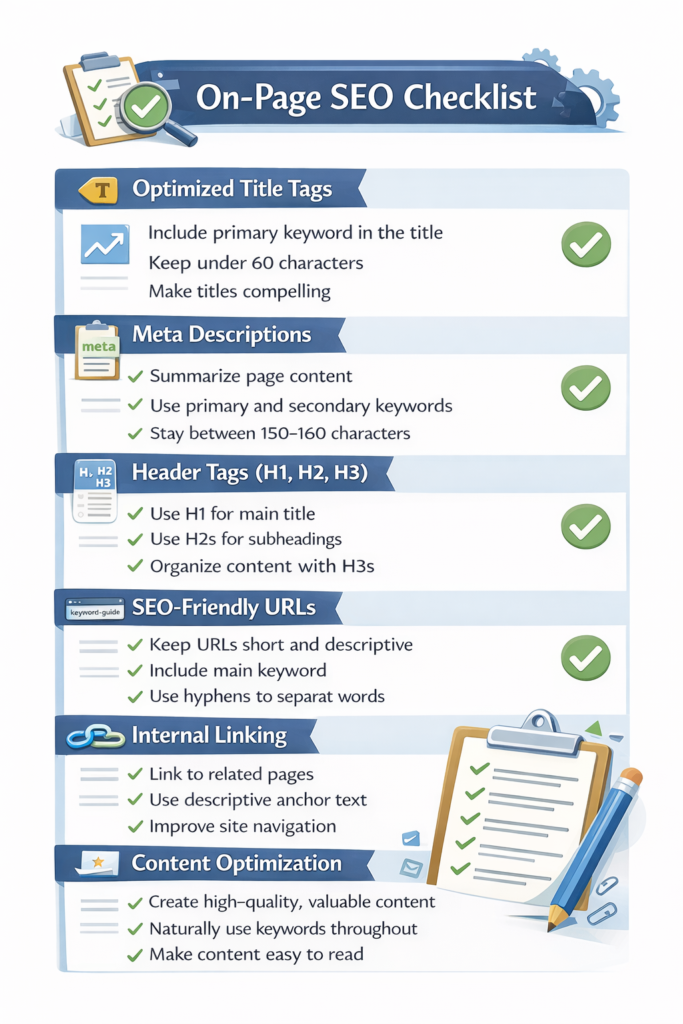
Title Tags Optimization
The title tag is one of the most important on-page SEO elements. It appears in SERPs and browser tabs, signaling the topic of your page.
Best Practices:
- Include primary keywords near the start.
- Keep titles under 60 characters.
- Make them compelling to increase CTR.
Example: For a guide on SEO basics:
“SEO Basics: The Complete Guide to SEO Fundamentals for Beginners”
Meta Descriptions
Keywords:
- meta description seo
- how to write meta descriptions
Meta descriptions summarize your page content in 150–160 characters. They don’t directly affect rankings but influence click-through rate (CTR).
Best Practices:
- Include primary and secondary keywords naturally.
- Highlight benefits or value to the reader.
- Add a call-to-action when relevant.
Example:
“Learn SEO basics and fundamentals in this complete beginner’s guide – from keyword research to on-page and technical SEO.”
Header Tags (H1, H2, H3)
Header tags organize content, making it scannable for readers and understandable for search engines.
Best Practices:
- Use H1 for the main page title (only once).
- Use H2s for main sections, H3s for subsections.
- Include relevant keywords naturally.
Example:
H2: “On-Page SEO Basics”
H3: “Title Tags Optimization”
URL Optimization
Optimized URLs help search engines and users understand page content.
Best Practices:
- Keep URLs short and descriptive.
- Include primary keywords.
- Use hyphens to separate words.
Example:/seo-basics-guide or /on-page-seo-optimization
Image SEO
Optimizing images improves accessibility, user experience, and rankings.
Best Practices:
- Use descriptive alt text with relevant keywords.
- Compress images for faster loading.
- Name image files with keywords, e.g.,
seo-basics-checklist.jpg.
Internal Linking
Internal links guide users and search engines through your site.
Best Practices:
- Link to related pages naturally.
- Use descriptive anchor text.
- Maintain a logical site hierarchy.
Example: Linking from “Keyword Research” section to /keyword-research-guide.
Content Optimization
High-quality content should be:
- Well-structured with headings.
- Keyword-rich but natural.
- Scannable with bullet points, lists, and images.
- Updated regularly to maintain relevance.
Example: Integrate primary, secondary, and long-tail keywords throughout the article while keeping sentences natural.
Creating SEO-Friendly Content
Optimized content aligns with search intent, addresses user needs, and signals topical authority to both Google and AI engines.
Search Intent Optimization
Understanding search intent is critical. There are three main types:
- Informational: Users want to learn something (e.g., “what is SEO”).
- Commercial: Users are researching options or comparing solutions (e.g., “best SEO tools for beginners”).
- Transactional: Users are ready to act or purchase (e.g., “hire SEO expert”).
Creating SEO-friendly content ensures that your website not only ranks well in search engines but also provides real value to your audience.
Best Practice: Tailor content to satisfy the intent, using headings, examples, and calls-to-action that align with the query.
Writing High-Quality Content
High-quality content is:
- Useful: Solves a real problem for the reader.
- Comprehensive: Covers the topic in depth.
- Readable: Well-structured with headings, bullet points, and visuals.
- Accurate: Supported by credible sources or real-world data.
Example: A guide on SEO basics should include step-by-step instructions, screenshots, and actionable examples to help beginners implement strategies.
Content Length and SEO
Long-form content (2,500–4,000 words) tends to perform better in search engines because:
- It covers topics comprehensively.
- It increases dwell time and engagement.
- It naturally includes more keywords and semantic variations.
Tip: Break content into scannable sections with H2/H3 headings for easy navigation.
Content Freshness
Keeping content up-to-date improves rankings and authority:
- Update statistics, links, and examples regularly.
- Refresh old posts to maintain relevance for trending searches.
- Create evergreen content that remains valuable over time (e.g., “SEO fundamentals guide”).
Example: Updating a blog post on SEO in 2026 to reflect AI search trends, generative SEO tools, and Google algorithm changes.
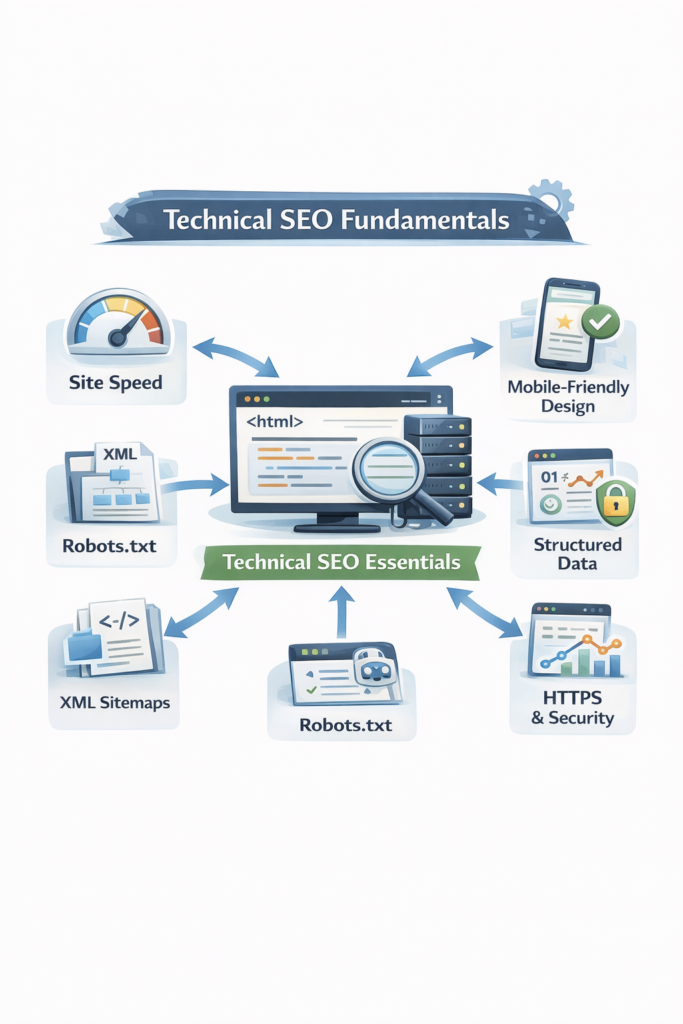
Technical SEO Fundamentals
Technical SEO ensures that your website is crawlable, indexable, and fast, providing both search engines and users with an optimal experience.
Proper technical SEO lays the foundation for all other SEO efforts, improving visibility, rankings, and site performance.
Site Speed Optimization
Page speed is a critical ranking factor and directly impacts user experience. Slow-loading pages increase bounce rates and reduce dwell time.
Best Practices:
- Compress images and use next-gen formats (WebP).
- Minimize CSS, JavaScript, and HTML.
- Implement browser caching and a content delivery network (CDN).
- Use tools like Google PageSpeed Insights or Lighthouse for analysis.
Mobile Optimization
Keywords:
- mobile friendly website seo
- mobile first indexing
With mobile-first indexing, Google predominantly uses the mobile version of your site for ranking and indexing.
Best Practices:
- Ensure responsive design across devices.
- Optimize tap targets and font sizes for mobile readability.
- Prioritize loading speed for mobile users.
- Test using Google Mobile-Friendly Test.
XML Sitemaps
Sitemaps help search engines discover and index your pages efficiently.
Best Practices:
- Include all important pages, exclude low-value URLs.
- Submit sitemap via Google Search Console and Bing Webmaster Tools.
- Keep it updated whenever content changes.
Example:https://example.com/sitemap.xml
Robots.txt
The robots.txt file guides search engine crawlers on which pages to crawl or avoid.
Best Practices:
- Block duplicate content or admin pages.
- Ensure important pages are not accidentally blocked.
- Regularly test using the robots.txt tester in Google Search Console.
HTTPS and Security
Secure websites (HTTPS) are prioritized in search rankings and improve user trust.
Best Practices:
- Install a valid SSL certificate.
- Redirect all HTTP traffic to HTTPS.
- Monitor for mixed content issues (insecure assets on secure pages).
Structured Data
Structured data helps search engines understand content context and increases the likelihood of rich results like featured snippets.
Best Practices:
- Use JSON-LD format recommended by Google.
- Apply schema for:
- Articles & Blogs
- FAQs
- Products & Services
- Test structured data using Google Rich Results Test.
Link Building Basics
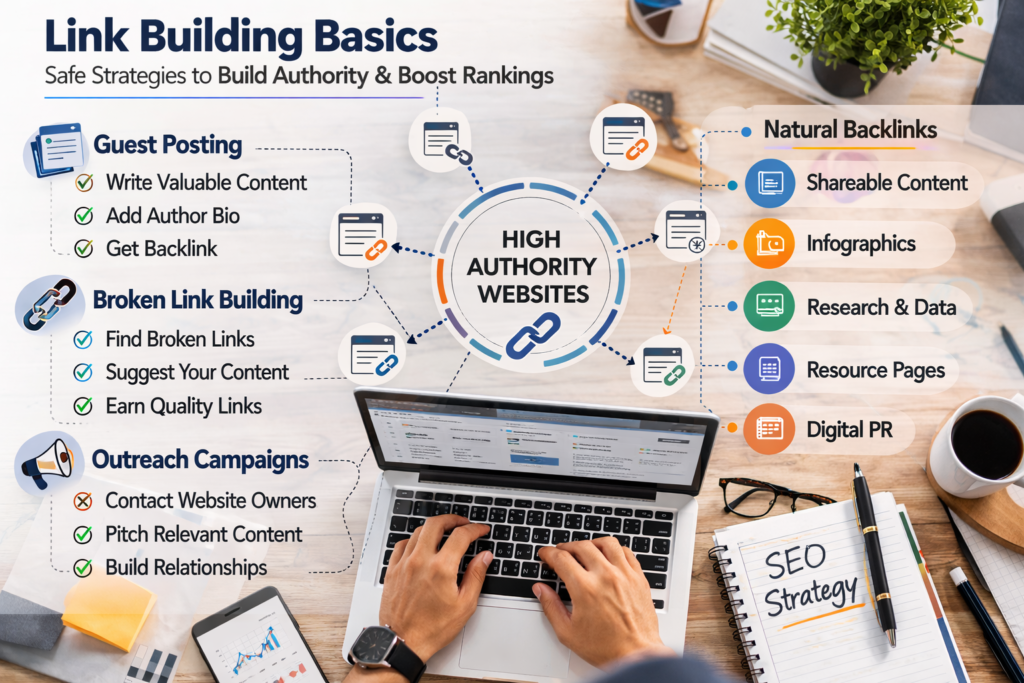
Link building is the process of acquiring high-quality backlinks from other websites to your own. Backlinks are one of the most important ranking signals in SEO because they indicate authority, trust, and relevance.
What Are Backlinks
A backlink is a link from one website to another. Search engines view backlinks as votes of confidence, helping your site rank higher in search results.
Example: If example.com links to your SEO guide, Google interprets this as a signal that your content is credible and valuable.
Types of Backlinks
Best Practice: Aim for a diverse backlink profile with authoritative and relevant sources.
Safe Link Building Strategies
Focus on ethical strategies to avoid penalties:
- Create valuable, shareable content.
- Build relationships with industry bloggers and journalists.
- Earn links naturally through thought leadership and research.
Avoid black-hat tactics like buying links, link farms, or spammy directories.
Link Building Methods
Effective Methods:
- Guest Posting: Write high-quality articles for authoritative websites in your niche.
- Broken Link Building: Find broken links on relevant sites and suggest your content as a replacement.
- Outreach Campaigns: Reach out to influencers, bloggers, and businesses to share your content.
- Resource Pages & Skyscraper Technique: Create better content than competitors and pitch it to sites linking to similar resources.
User Experience and SEO
User experience (UX) is a critical component of SEO. Google increasingly prioritizes websites that provide fast, intuitive, and enjoyable experiences.
A positive UX improves engagement, dwell time, and conversion rates, which in turn influence rankings.
Core Web Vitals
Core Web Vitals measure page experience and speed, including:
- Largest Contentful Paint (LCP): Measures loading performance. Aim < 2.5 seconds.
- First Input Delay (FID): Measures interactivity. Aim < 100ms.
- Cumulative Layout Shift (CLS): Measures visual stability. Aim < 0.1.
Best Practices:
- Optimize images and server response times.
- Minimize render-blocking scripts.
- Avoid unexpected page shifts by setting explicit image and video dimensions.
Website Navigation
Clear, logical navigation helps both users and search engines:
- Use descriptive menus and breadcrumbs.
- Organize pages into clusters or categories.
- Ensure important pages are accessible within 3 clicks from the homepage.
- Internal linking strengthens topical authority and spreads link equity.
Bounce Rate and Dwell Time
Bounce Rate: Percentage of users leaving after viewing a single page.
Dwell Time: Time users spend on your page before returning to search results.
Best Practices:
- Create engaging, scannable content with headings and visuals.
- Include internal links to related content.
- Improve page speed and mobile responsiveness.
Tip: Longer dwell time signals content relevance and quality, improving SEO performance.:
User Experience and SEO
User experience (UX) is a critical component of SEO. Google increasingly prioritizes websites that provide fast, intuitive, and enjoyable experiences.
A positive UX improves engagement, dwell time, and conversion rates, which in turn influence rankings.
Core Web Vitals
Core Web Vitals measure page experience and speed, including:
- Largest Contentful Paint (LCP): Measures loading performance. Aim < 2.5 seconds.
- First Input Delay (FID): Measures interactivity. Aim < 100ms.
- Cumulative Layout Shift (CLS): Measures visual stability. Aim < 0.1.
Best Practices:
- Optimize images and server response times.
- Minimize render-blocking scripts.
- Avoid unexpected page shifts by setting explicit image and video dimensions.
Website Navigation
Keywords:
- site architecture seo
- website structure seo
Clear, logical navigation helps both users and search engines:
- Use descriptive menus and breadcrumbs.
- Organize pages into clusters or categories.
- Ensure important pages are accessible within 3 clicks from the homepage.
- Internal linking strengthens topical authority and spreads link equity.
Bounce Rate and Dwell Time
Bounce Rate: Percentage of users leaving after viewing a single page.
Dwell Time: Time users spend on your page before returning to search results.
Best Practices:
- Create engaging, scannable content with headings and visuals.
- Include internal links to related content.
- Improve page speed and mobile responsiveness.
Tip: Longer dwell time signals content relevance and quality, improving SEO performance.
SEO Tools Beginners Should Use
Using the right SEO tools allows beginners and professionals to analyze, optimize, and track their websites effectively. Tools help with keyword research, technical audits, backlink analysis, and content optimization, saving time and improving results.
Google SEO Tools
Key Tools:
- Google Search Console (GSC):
- Monitor indexing status.
- Identify crawl errors and security issues.
- Track keyword performance and CTR.
- Google Analytics:
- Measure organic traffic and user behavior.
- Track conversion rates and engagement metrics.
- Analyze which pages drive highest SEO ROI.
Tip: Linking GSC with Google Analytics gives a comprehensive SEO performance view.
Keyword Research Tools
Functionality:
- Identify high-volume, low-competition keywords.
- Analyze competitors’ top-ranking keywords.
- Discover content gaps and long-tail opportunities.
Tip: Combine multiple tools to validate data and capture a wide range of keyword insights.
Technical SEO Tools
Keywords:
- screaming frog seo
- site audit tools
Functionality:
- Crawl websites to identify technical issues.
- Check broken links, duplicate content, redirects, and meta issues.
- Analyze page speed, mobile optimization, and Core Web Vitals.
Other Useful Tools:
- Ahrefs / SEMrush for backlink audits.
- Lighthouse for performance insights.
- GTmetrix for page speed analysis.
How to Measure SEO Success
Measuring SEO success ensures your strategies are working and driving results. Tracking metrics like traffic, rankings, and conversions allows you to refine your approach and demonstrate ROI.
Organic Traffic
Definition: Organic traffic represents visitors who reach your website via unpaid search results.
Best Practices:
- Track monthly organic sessions in Google Analytics.
- Analyze traffic trends for key landing pages.
- Compare organic vs paid traffic to assess SEO impact.
Tip: Use segmentation to see which content drives the most targeted traffic.
Keyword Rankings
Definition: Keyword rankings show where your pages appear in search engine results pages (SERPs).
Best Practices:
- Monitor primary and long-tail keyword positions regularly.
- Track ranking fluctuations after content updates or link building.
- Use tools like Ahrefs, SEMrush, or Google Search Console for accurate insights.
Tip: Focus on keywords that drive traffic and conversions, not just volume.
Conversion Rate
Definition: Conversion rate measures the percentage of visitors who complete a desired action (e.g., contact form, purchase, download).
Best Practices:
- Track conversions using Google Analytics goals or events.
- Optimize high-traffic pages with clear CTAs.
- Analyze user behavior to improve page flow and engagement.
Tip: SEO success is not just traffic, but quality traffic that converts.
SEO Reporting
Best Practices:
- Create monthly SEO reports including traffic, ranking, and conversion data.
- Highlight top-performing pages and keywords.
- Include technical improvements and upcoming SEO opportunities.
Tip: Reports should be actionable and easy to understand for stakeholders and team members.
Common SEO Mistakes Beginners Should Avoid
Many beginners make avoidable SEO mistakes that can hinder rankings and traffic. Recognizing these pitfalls helps ensure your SEO efforts are effective and sustainable.
Keyword Stuffing
Definition: Keyword stuffing occurs when keywords are overused unnaturally within content.
Impact:
- Reduces readability and user experience.
- Can trigger Google penalties.
- Signals low-quality content to search engines.
Best Practice:
- Use keywords naturally and contextually.
- Focus on semantic variations and long-tail keywords.
Duplicate Content
Definition: Duplicate content is identical or very similar content appearing on multiple URLs.
Impact:
- Dilutes ranking signals.
- Confuses search engines about which page to index.
Best Practice:
- Use canonical tags.
- Avoid copying content from other websites.
- Rewrite content for uniqueness.
Buying Backlinks
Impact:
- Low-quality links can trigger Google penalties.
- Offers short-term gains but long-term risks are high.
Best Practice:
- Focus on white-hat link building strategies (guest posting, outreach, natural links).
Ignoring Technical SEO
Impact:
- Poor site structure and slow pages limit crawlability and indexing.
- Can prevent high-quality content from ranking.
Best Practice:
- Conduct regular technical audits.
- Optimize site speed, mobile usability, and structured data.
Thin Content
Definition: Pages with little or no value to the user.
Impact:
- Reduces organic traffic potential.
- Fails to satisfy search intent.
Best Practice:
- Create comprehensive, helpful, and in-depth content.
- Aim for content that answers questions and solves problems.
The Future of SEO
SEO is evolving rapidly with AI, voice search, semantic understanding, and advanced algorithms reshaping how websites rank. Staying ahead of trends is crucial for businesses, marketers, and beginners looking to maintain long-term visibility.
AI and SEO
Overview: AI tools and search engines (e.g., ChatGPT, Perplexity, Gemini, Bing Copilot) are influencing how content is ranked, summarized, and cited.
Implications:
- Content must be authoritative, semantically relevant, and entity-optimized.
- AI can generate content ideas, detect gaps, and analyze SERPs.
Best Practice:
- Leverage AI to enhance human-written content, not replace it.
- Ensure accuracy, expertise, and EEAT signals in content.
Voice Search SEO
Overview: Voice assistants like Google Assistant, Alexa, and Siri are driving conversational search queries.
Implications:
- Users often ask question-based, long-tail queries.
- Featured snippets and FAQs are increasingly important.
Best Practice:
- Optimize content for natural language queries.
- Include FAQ sections and structured data to capture voice search traffic.
Semantic Search
Overview: Google and Bing now focus on context, intent, and entity relationships rather than exact keywords.
Implications:
- Content must demonstrate topical authority and semantic relevance.
- Entities, synonyms, and related concepts boost SERP performance.
Best Practice:
- Map content around core entities and concepts.
- Use internal linking and semantic keywords to reinforce topical authority.
Google Helpful Content Update
Overview: Google prioritizes content written for people, not search engines, rewarding expertise, depth, and utility.
Implications:
- Thin, AI-generated, or low-value content is demoted in rankings.
- Focus on clear, actionable, and useful content.
Best Practice:
- Write for human readers first, then optimize for search engines.
- Demonstrate experience, authority, and trustworthiness in your content.
SEO Basics Checklist (Beginner Action Plan)
A clear, actionable checklist helps beginners systematically implement SEO and ensures no critical steps are missed. This framework can also serve as a reference for ongoing optimization.
SEO Checklist Steps
- Keyword Research
- Identify primary, secondary, and long-tail keywords relevant to your niche.
- Use tools like Google Keyword Planner, SEMrush, Ahrefs, and Ubersuggest.
- Prioritize keywords based on search intent, volume, and competition.
- Optimize Titles & Meta Descriptions
- Include target keywords naturally in titles and meta descriptions.
- Ensure titles are compelling for clicks and meta descriptions summarize page value.
- Publish Quality Content
- Create high-quality, helpful, and in-depth articles.
- Address user intent clearly and provide actionable guidance.
- Incorporate semantic keywords and entities to strengthen topical relevance.
- On-Page SEO Optimization
- Use proper header tags (H1, H2, H3) for structure.
- Optimize URL structure, image alt tags, and internal linking.
- Implement structured data where appropriate (FAQ, HowTo).
- Build Backlinks
- Focus on white-hat link-building strategies like guest posting, outreach, and content promotion.
- Avoid purchased or low-quality links.
- Monitor Analytics & Performance
- Track organic traffic, keyword rankings, and conversions.
- Use Google Analytics, Search Console, and SEO reporting tools.
- Adjust strategy based on performance insights and trends.
People Also Ask (PAA)
Theses are common SEO questions users search for online.
These quick answers explain essential concepts, helping beginners understand how search engine optimization works and how to apply it effectively.
What is SEO and how does it work?
SEO (Search Engine Optimization) is the practice of improving a website’s visibility on search engines.
It works by optimizing content, site structure, technical performance, and backlinks to align with search intent, helping pages rank higher and attract organic traffic from Google, Bing, and other search platforms.
How Do Beginners Start SEO?
Beginners start SEO by learning keyword research, on-page optimization, content creation, and basic technical SEO. Begin with optimizing titles, meta descriptions, headings, and URLs, then create high-quality, user-focused content.
Use free tools like Google Search Console and Analytics to monitor performance and improve results over time.
How Long Does SEO Take?
SEO results vary depending on competition, website authority, and content quality. Initial improvements can appear in 3–6 months, while achieving top rankings for competitive terms may take 6–12 months.
Consistency in content creation, link building, and technical optimization accelerates results.
Is SEO Difficult to Learn?
SEO can seem complex at first, but beginners can learn the basics with structured resources and practical experience.
Focus on keyword research, content optimization, and technical fundamentals.
Regular practice and monitoring results make SEO increasingly understandable and manageable over time.
Can I Do SEO Myself?
Yes, individuals can implement SEO themselves, especially for small websites or blogs. Start with keyword research, on-page optimization, and content creation.
For advanced strategies like link building or technical audits, consider guides, courses, or professional SEO tools to maximize results efficiently.
How to Rank on Google?
To rank on Google, optimize for user intent and search relevance. Conduct keyword research, create high-quality content, ensure technical SEO is sound, and acquire authoritative backlinks.
Monitor performance via Google Analytics and Search Console and adjust strategies based on rankings and traffic trends.
Does SEO Still Work in 2026?
Yes, SEO remains effective in 2026, though strategies have evolved. AI search engines, semantic search, and user-focused content now dominate rankings.
Businesses that prioritize EEAT, content quality, and entity-based optimization will continue to benefit from long-term organic traffic growth.
How Much Does SEO Cost?
SEO costs vary based on scope, competition, and provider. Freelancers may charge $500–$2,000/month, while agencies range from $2,000–$10,000/month for comprehensive strategies.
DIY approaches reduce costs but require time, tools, and consistent effort to achieve meaningful results.

SEO Basics FAQ
How Long Does SEO Take to Work?
SEO results depend on website age, competition, and content quality. Realistically, beginners may see initial improvements in 3–6 months, while competitive keywords may take 6–12 months for top rankings.
The key is to remain consistent with content creation, technical optimization, and backlink building, which accelerate results over time.
Can I Learn SEO on My Own?
Yes, self-learning SEO is absolutely possible using online tutorials, guides, and tools. Start with keyword research, on-page SEO, and content optimization, then progress to technical SEO and link-building strategies.
With regular practice and tracking results, you can build proficiency even without formal training. You can also accelerate learning by seeking mentorship from experienced SEO professionals.
Is SEO Free or Paid?
SEO can be free if you implement strategies yourself using Google Search Console, Analytics, and free tools.
Paid options, like agencies, software, or advanced keyword tools, can speed results and provide expert insights but are not mandatory for basic SEO success.
How Much Does SEO Cost?
SEO costs vary. Small businesses doing DIY SEO spend minimal money, mostly on tools (~$50–$200/month).
Hiring freelancers or agencies ranges from $500 to $5,000/month depending on strategy complexity, competition, and content volume. Cost reflects time, expertise, and results potential.
What Is the Best SEO Strategy for Beginners?
The best SEO strategy for beginners focuses on foundational steps:
- Conduct keyword research
- Optimize titles, meta descriptions, headings, and URLs
- Create high-quality, helpful content
- Build white-hat backlinks
- Monitor analytics and rankings regularly. Consistency and incremental improvement are key to long-term success.:
Still have more questions?
Talk To an Expert
Ready to Grow Your Organic Traffic?
Learning SEO is the first step. For faster results, expert strategy, and sustainable growth, work with experienced SEO professionals.