How to Rank and Sell on Amazon Without Ads: The Complete Guide
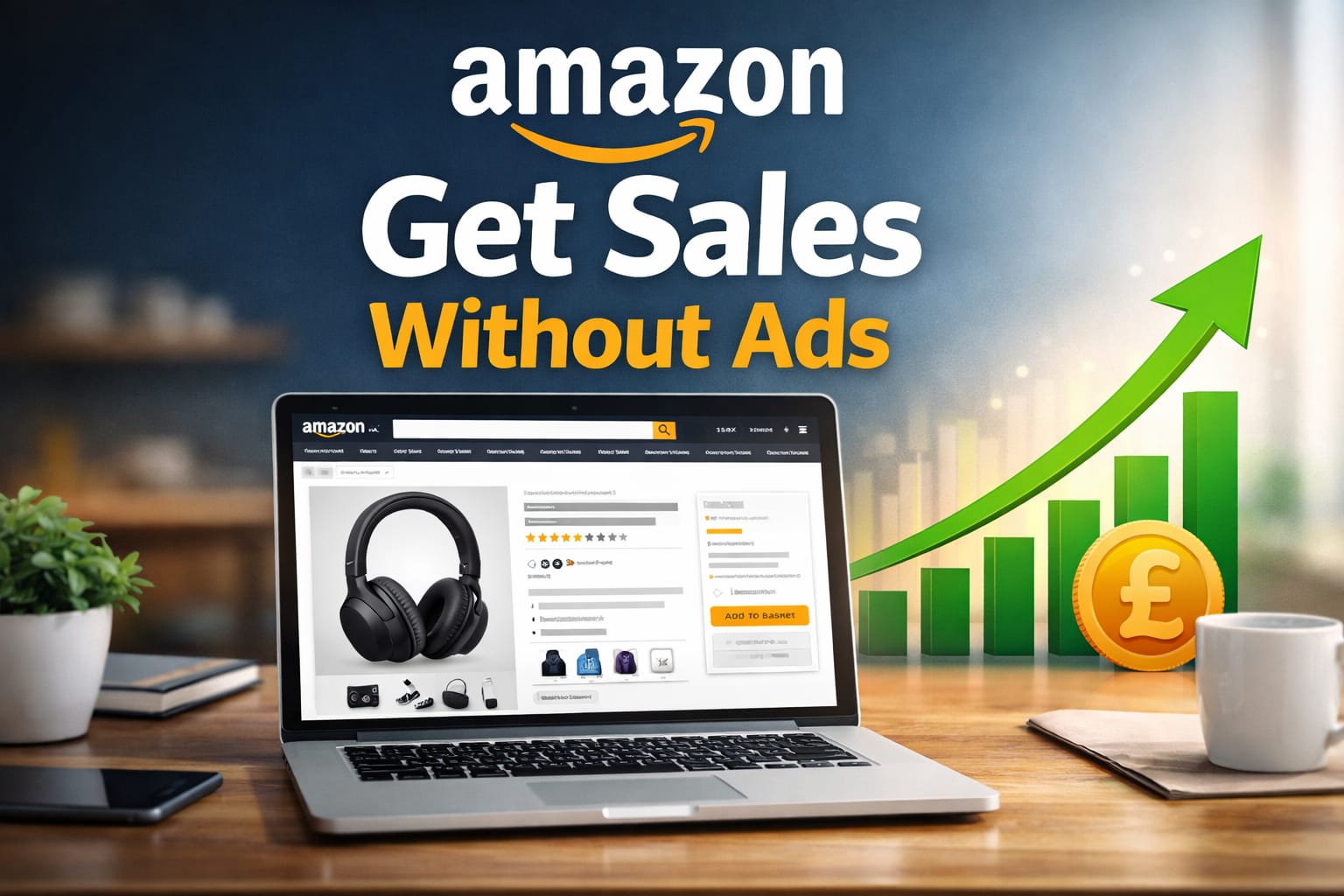
Rank and Sell on Amazon Without Ads
Getting your product onto page 1 of Amazon and generating consistent sales is one of the biggest challenges for new sellers. While ads can accelerate growth, they aren’t the only path.
With the right strategies, you can rank, sell, and grow your Amazon business organically, leveraging SEO, conversion optimization, reviews, external traffic, and AI-driven techniques.
Understanding Amazon SEO and How Products Rank
Amazon’s goal is simple: show customers products they are most likely to buy. Your success depends on three key factors:
- Visibility: Being found in Amazon search results
- Conversion Rate: Turning visitors into buyers
- Customer Trust: Reviews, ratings, and product quality
Key Ranking Signals on Amazon
Amazon’s A9 algorithm prioritizes products that are most likely to sell:
- Sales Velocity: How quickly your product generates purchases
- Conversion Rate: Percentage of visitors who actually buy
- Relevance: How well your listing matches search queries
- Customer Feedback: Ratings and reviews
- Pricing & Availability: Competitive pricing and fulfillment method (FBA vs FBM)
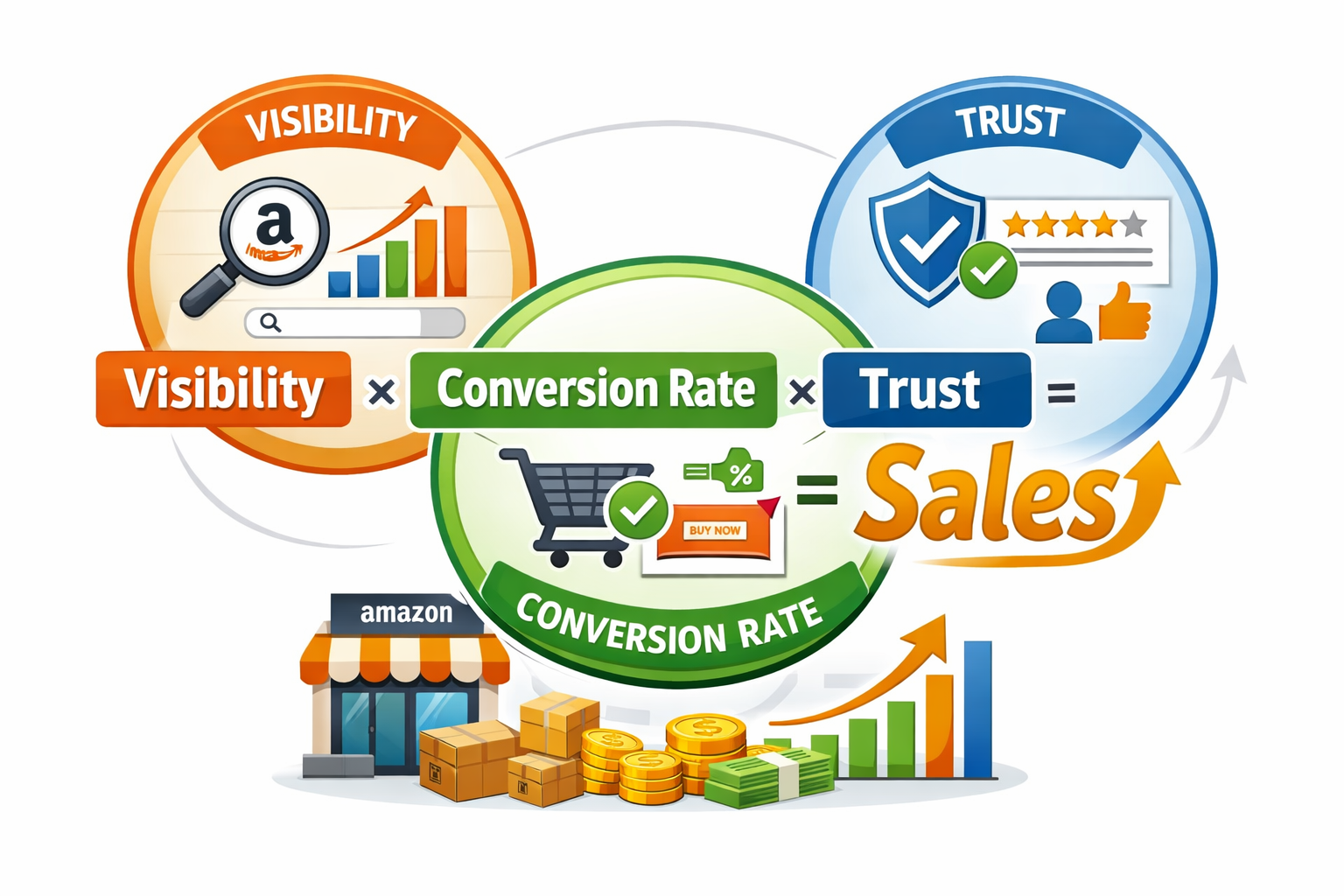
Now that we understand how Amazon evaluates products through visibility, conversion rate, and customer trust the next step is to choose a product that can capitalize on these ranking signals.
1. Choose a Low-Competition Product
Picking a low-competition product is critical because it allows your listing to gain visibility faster, achieve conversions more easily, and start building customer trust without being buried under hundreds of competing listings.
In other words, your product choice directly impacts the very metrics Amazon uses to rank listings.”
Product selection is the foundation of organic success.
Avoid:
- Highly saturated markets dominated by big brands
- Listings with thousands of reviews
- Broad or generic products
Target:
- Niches where top listings have under 300 reviews
- Specific, targeted products (e.g., “non-slip yoga mat for beginners”)
- Opportunities to improve existing products
Why it works (AEO Insight): Less competition allows faster ranking and higher sales without relying on ads.
Snippet Opportunity: “How to choose low-competition products on Amazon?”
Once you’ve selected a product that offers the best chance to rank, the next step is to optimize your listing to convert visibility into sales.
Even a low-competition product won’t perform if it isn’t discoverable, compelling, and aligned with Amazon’s ranking signals.
This is where Amazon SEO (AEO) and AI-friendly optimization (GEO) come together: structuring your title, bullets, description, and backend keywords to match buyer intent while maximizing organic reach.”
2. Optimize Your Listing for Amazon SEO
Optimizing your listing is about visibility, relevance, and conversion. Every element contributes to how Amazon evaluates your product and how AI search engines interpret your content.
Your listing must be discoverable and highly clickable. Focus on:
Title Optimization
- Include primary keyword + main benefit
- Keep it clear, descriptive, and compelling
- Highlight differentiators (size, brand, unique feature)
- Avoid keyword stuffing; focus on human readability
Example:
Before: “Yoga Mat”
After: “Non-Slip Yoga Mat for Beginners – Extra Thick, Eco-Friendly & Durable”
Snippet Opportunity: “How to write Amazon product titles that rank and convert?”
Bullet Points
- Feature-focused and scannable
- Include secondary keyword variations naturally
- Highlight benefits, not just features
- Use short sentences for better AI parsing
Example Before → After Table Suggestion:
| Before | After |
|---|---|
| Lightweight yoga mat | Non-slip yoga mat for beginners – lightweight yet durable, perfect for home or studio |
Product Description
- Clearly explain product value and use cases
- Use short paragraphs with subheadings
- Incorporate long-tail keywords naturally
- Include semantic terms to help AI search engines understand context
Tip: Think “How would I describe this to someone who has never seen it?”
Backend Keywords
- Fill all available slots in Seller Central
- Include synonyms, variations, and related phrases
- Target long-tail keywords not in your visible copy
- Supports semantic SEO and AI indexing
3. Maximize Your Conversion Rate
Once your listing is optimized for search, the next critical step is turning visitors into buyers.
On Amazon, conversion rate is one of the strongest ranking signals, so even small improvements can boost both sales and visibility. Every visitor counts when you’re not using ads. Focus on:
High-Quality Images
- Use clear, professional photos showing multiple angles
- Include lifestyle images demonstrating the product in use
- Highlight key features visually (size, texture, functionality)
- Ensure images meet Amazon’s guidelines for resolution and format
Snippet Opportunity: “How to improve Amazon product conversion with images?”
Strong Main Image
- Your main image drives clicks from search results, so it must be compelling
- Use white background, clear product focus, and good lighting
- Avoid clutter or distractions
Visual Cue: Example of optimized vs. poor main image
Competitive Pricing
- Price strategically to encourage early sales
- Consider launch discounts or limited-time offers
- Price should reflect value perception without sacrificing profit
Snippet Opportunity: “Does pricing influence Amazon sales and ranking?”
Clear Benefits Explanation
- Highlight why your product is better than alternatives
- Focus on problem-solving features rather than just specifications
- Use bullet points and concise language for scannability
Visual Cue: Bullet points illustrating feature → benefit mapping
Additional Tips for Conversion Optimization
- Use A+ Content (Enhanced Brand Content) to improve trust and conversion
- Include comparison charts to show advantages over competitors
- Incorporate keywords naturally in bullets and descriptions for semantic relevance
- Encourage review generation as social proof, which reinforces conversion
Key Takeaway:
Conversion rate directly impacts Amazon ranking. By focusing on high-quality visuals, compelling descriptions, competitive pricing, and clear benefits, you can turn more visitors into buyers and strengthen your SEO signals.
4. Drive External Traffic
Even the most optimized Amazon listing benefits when you bring in external buyers, because Amazon rewards listings that generate consistent sales from outside sources.
Driving traffic strategically can boost both conversion rate and sales velocity, which improves your AEO (Amazon SEO) ranking and signals relevance to AI search engines (GEO).
Platforms to Use
- TikTok: Short, engaging videos demonstrating your product in action
- Instagram: Reels, stories, and posts to reach niche audiences
- Facebook: Targeted groups and personal networks for interest-based traffic
- YouTube: Tutorials, problem/solution content, or unboxing videos
Snippet Opportunity: “How can social media traffic improve Amazon rankings?”
Content Types That Work
- Product demonstrations: Show your product solving a problem
- Problem/solution videos: Highlight a challenge your product addresses
- Short, engaging clips: Keep attention high; ideal for TikTok and Instagram Reels
- Testimonials & user-generated content: Builds trust and social proof
Flow of External Traffic → Amazon → Ranking Boost
Tips for Maximizing Traffic Effectiveness
- Track results: Use Amazon attribution links to monitor which platforms drive the most sales.
- Target your audience: Focus on platforms where your niche customers are active.
- Engage consistently: Regular posts and video content compound results over time.
- Combine with SEO signals: Ensure landing pages, posts, or videos use keywords and semantic terms that align with your Amazon listing.
Key Takeaway:
Driving external traffic doesn’t just generate sales, it signals Amazon that your product is in demand, improving ranking, conversion rate, and discoverability in AI-powered search results.
Even small, consistent flows of buyers from social media or blogs can have an outsized impact.
5. Get Your First Reviews Quickly
Reviews build trust, and trust drives sales. Without a strong review base, even well-optimized listings may struggle to convert.
Early reviews are a crucial ranking signal for Amazon’s algorithm (A9) and reinforce social proof for AI search engines, improving visibility and recommendation chances.
Request Reviews via Amazon Features
- Use Amazon’s “Request a Review” button in Seller Central for every order.
- Ensures compliance with Amazon policies while encouraging genuine feedback.
- Automates review invitations, increasing your chance of early reviews.
Deliver Excellent Customer Service
- Respond promptly to questions and concerns.
- Solve issues before they result in negative feedback.
- Personal touches create repeat customers and positive word-of-mouth.
Include Packaging Inserts
- Add policy-compliant inserts thanking buyers and encouraging reviews.
- Example: “We hope you love your new yoga mat! Please leave an honest review to help others.”
- Avoid asking for 5-star reviews explicitly to remain compliant with Amazon rules.
Use Amazon Vine (if Eligible)
- Amazon Vine allows select sellers to receive early, trusted reviews from Vine members.
- Boosts initial credibility, especially for new product launches.
Additional Tips for Review Growth
- Focus on early 5–15 reviews: this initial batch heavily influences sales velocity and conversion.
- Encourage authentic user-generated content, like photos or video reviews, which improve AI readability and ranking signals.
- Combine review growth with external traffic campaigns to accelerate visibility.
Key Takeaway:
Reviews are not just social proof, they’re a ranking multiplier. Early, authentic reviews help your product convert better, rank faster, and signal authority to AI-driven search engines, increasing both organic sales and long-term growth.
6. Focus on One Keyword at a Time
Many Amazon sellers make the mistake of trying to rank for too many keywords at once, which dilutes your listing’s relevance.
Focusing on a single primary keyword allows you to concentrate all ranking signals, visibility, conversion, and trust, on one target, improving your chances of hitting page 1 faster.
Choose a Primary Keyword
- Select a long-tail, high-intent keyword closely aligned with your product.
- Example: Instead of “yoga mat,” use “non-slip yoga mat for beginners.”
- Use keyword research tools like Helium 10, Jungle Scout, or AMZScout to identify high-conversion, low-competition terms.
Snippet Opportunity: “Why should Amazon sellers focus on one keyword at a time?”
Optimize Listing Around It
- Include your primary keyword in:
- Title
- Bullet points
- Product description
- Backend keywords
- This concentrates semantic relevance for both Amazon’s algorithm and AI-driven search engines.
- Avoid keyword stuffing; maintain natural, human-readable language.
Expand to Related Keywords Gradually
- Once your primary keyword gains traction and sales velocity, introduce secondary keywords.
- Target long-tail variations that support your main keyword semantically, e.g., “eco-friendly yoga mat for beginners” or “extra thick non-slip yoga mat.”
- This strategy builds semantic SEO depth and strengthens your listing’s authority across multiple queries.
Tips for Maximum Impact (AEO + GEO)
- Use semantic keyword clusters: your primary keyword plus related terms enhances AI readability.
- Align external traffic and content marketing with your primary keyword for additional ranking signals.
- Monitor click-through rate (CTR) and conversion to see if the keyword is attracting the right buyers.
Key Takeaway:
Concentrating on one primary keyword at a time allows your listing to maximize ranking potential, AI discoverability, and conversion efficiency.
Once momentum is gained, expanding into related keywords multiplies your traffic and sales opportunities organically.
7. Use Your Network to Kickstart Sales
Early sales momentum is critical for Amazon’s algorithm. Even a perfectly optimized listing can struggle if it lacks initial sales velocity and social proof.
Leveraging your personal and professional network is a powerful way to jumpstart your product’s performance organically.
Share with Friends and Network
- Introduce your product to friends, family, and professional contacts who may be interested.
- Ask for genuine feedback or early purchases—never fake reviews, as this violates Amazon policies.
- Encourage them to leave authentic reviews, which boosts trust and conversion.
Promote Through Personal Channels
- Use email newsletters, social media profiles, or business pages to announce your product launch.
- Provide helpful guides or demonstrations rather than a hard sell—this increases engagement and click-through to Amazon listings.
- Align messaging with your primary keyword and semantic SEO terms to strengthen relevance.
Ensure Genuine Purchases
- Amazon rewards authentic purchase activity in early stages.
- Avoid manipulative tactics like incentivized reviews or fake orders.
- Focus on building real customer trust, which also signals authority to AI search engines.
Tips for Maximizing Impact (AEO + GEO)
- Track initial sales and reviews to monitor early ranking signals.
- Combine network-driven traffic with listing optimization and external campaigns for compounded effects.
- Highlight unique features and problem-solving benefits in network promotions to boost conversions.
Key Takeaway:
Your network can provide the initial sales velocity and social proof that Amazon and AI search engines need to take your listing seriously.
Authentic early purchases and reviews strengthen your visibility, conversion rate, and trust metrics, setting up sustainable organic growth.
8. Be Patient and Consistent
Organic growth on Amazon doesn’t happen overnight. Even with a perfectly optimized listing, early traffic, and initial reviews, you need patience and consistency to see sustained results.
Amazon’s algorithm rewards steady performance, and AI-driven tools recognize patterns of long-term relevance and trust.
Week 1–2: Minimal Visibility
- Expect very few impressions or clicks initially.
- Focus on monitoring listing performance and fixing minor issues:
- Spelling, grammar, or formatting errors
- Image clarity and alignment with product benefits
- Keyword coverage
Week 2–4: First Sales
- Early purchases start coming in, often from network promotion or external traffic.
- Encourage genuine reviews to begin building trust signals.
- Monitor conversion rates and CTR; optimize as needed.
Week 4–6: Gradual Ranking Improvement
- Listings start ranking higher for primary and secondary keywords.
- Sales velocity improves as Amazon perceives your product as relevant and in-demand.
- Continue consistent promotion, traffic generation, and customer engagement.
Tips for Consistency (AEO + GEO Boosting)
- Update listing regularly: refresh images, adjust bullets, and incorporate new keywords.
- Maintain external traffic efforts: small, steady flows reinforce sales velocity.
- Track metrics: impressions, CTR, conversion, and reviews to guide optimization.
- Avoid shortcuts: do not manipulate reviews or purchases; authenticity is critical.
Key Takeaway:
Consistency compounds small gains into long-term growth.
By patiently monitoring performance, improving your listing, and steadily generating traffic, your product signals relevance and trust to Amazon and AI search engines, leading to sustainable organic ranking and sales.
Advanced Strategies to Boost Ranking
Once you’ve established a solid foundation—optimized listing, early reviews, external traffic, and consistent sales, you can implement advanced strategies to further accelerate your Amazon ranking and organic sales.
These tactics combine SEO, conversion optimization, and AI-driven insights (GEO).
Optimize Listing (SEO & Conversion)
- Use A+ Content / Enhanced Brand Content for richer storytelling:
- Comparison charts
- Tables highlighting features
- Branded visuals to improve trust
- Ensure bullets, descriptions, and titles are keyword-rich yet natural
- Include semantic terms for AI search engines and generative tools
Snippet Opportunity: “How does A+ Content improve Amazon product ranking and sales?”
Leverage External Traffic
- Collaborate with micro- and nano-influencers to target niche audiences
- Guest posts on blogs and niche websites for contextual backlinks
- Short-form paid ads (Instagram Shopping, TikTok) can supplement organic campaigns
- External traffic reinforces sales velocity and conversion, signaling relevance to Amazon
Focus on Reviews (Social Proof)
- Use Amazon Vine if eligible for early credible reviews
- Encourage authentic photo/video reviews
- Provide excellent customer service to generate positive feedback loops
- Reviews increase both conversion rate and ranking signals
Strategic Pricing & Promotions
- Start with competitive or lower pricing to accelerate sales velocity
- Offer coupons, deals, or limited-time discounts without violating Amazon rules
- Gradually increase pricing as your product ranks higher
- Pricing combined with conversion rate affects algorithmic ranking and AI recommendations
Keyword Optimization
- Use tools like Helium 10, Jungle Scout, AMZScout to identify:
- Long-tail, low-competition, high-conversion keywords
- Semantic clusters to strengthen authority
- Target areas where big brands aren’t focusing
- Expand keywords gradually while maintaining primary keyword focus
Key Takeaway:
Advanced strategies combine listing optimization, social proof, external traffic, and semantic keyword targeting to accelerate Amazon ranking and boost organic sales.
Integrating these techniques signals relevance and authority to both Amazon’s A9 algorithm and AI search engines, giving you a competitive edge
Frequently Asked Questions (FAQ)
How do I rank my Amazon product without advertising?
Focus on organic ranking signals: choose a low-competition product, optimize your listing (title, bullets, description, backend keywords), secure initial reviews, drive external traffic, and maintain high conversion rates. Consistency and quality are key.
What are the main Amazon ranking factors?
Amazon prioritizes products based on sales velocity, conversion rate, relevance, customer reviews, pricing, and fulfillment method (FBA vs FBM). Listings that satisfy these signals are more likely to appear on page 1.
How does Amazon SEO differ from Google SEO?
Amazon SEO focuses on sales and conversion signals, whereas Google SEO focuses on content relevance and backlinks. On Amazon, your goal is to rank products likely to sell, not just rank for search traffic.
Does price impact Amazon SEO?
Indirectly. Competitive pricing affects conversion rate and sales velocity, both of which are Amazon ranking signals. Lower initial pricing can help your product gain early traction.
How do I optimize my Amazon product title?
Include primary keywords and key benefits, keep it descriptive, highlight differentiators (size, material, brand), and make it easy to read. Avoid keyword stuffing—clarity sells.
How do I find the best keywords for Amazon listings?
Use tools like Helium 10, Jungle Scout, or AMZScout to identify high-volume, low-competition, long-tail keywords. Focus on phrases buyers actually search for, not just broad categories.
Do product descriptions affect Amazon rankings?
Yes. Descriptions support keyword relevance, explain product value, and improve conversion. Using long-tail keywords and clear formatting (subheadings, bullet points) boosts discoverability.
What are long-tail keywords, and why are they important for Amazon?
Long-tail keywords are specific search phrases (e.g., “non-slip yoga mat for beginners”) with lower competition. They help you rank faster, attract qualified buyers, and improve conversion rates.
How can I get more reviews on Amazon?
Encourage reviews ethically via: Amazon’s Request a Review feature, excellent customer service, packaging inserts (policy-compliant), and Amazon Vine if eligible. Early reviews build trust and conversion, improving ranking.
How do AI search engines read Amazon listings?
Improve CTR by optimizing: main product image, title, and bullet points. Clear, high-quality visuals and concise benefit-focused copy attract clicks from search results.
How do ratings and reviews influence Amazon search results?
High ratings and positive reviews increase trust and conversion rates, which are key ranking factors. Listings with more reviews generally rank higher and convert better.
How can I increase my Amazon CTR?
AI engines scan keywords, semantic context, entity mentions, and structured content. Well-organized titles, bullet points, and descriptions improve discoverability in AI-powered search results.
Are free traffic sources effective for Amazon SEO?
Absolutely. Platforms like social media, niche blogs, and email lists can generate initial organic sales. Even a small number of external purchases improves ranking signals.
How does Amazon’s algorithm evaluate sales history?
Amazon tracks recent and historical sales performance. Products with consistent sales, even without ads, signal demand and relevancy, which improves rankings.
What semantic SEO techniques help Amazon products rank?
Include related keywords, synonyms, product attributes, and contextually relevant terms in your title, bullets, description, and backend keywords. This signals authority and topical relevance to Amazon and AI engines.
Is it possible to sell on Amazon without running ads?
Yes. By focusing on low-competition products, listing optimization, high conversion rates, initial reviews, and external traffic, sellers can grow organically and achieve consistent sales.
How do generative tools help optimize Amazon content?
Generative AI tools can suggest keywords, rewrite listings for clarity, craft bullet points, and create product descriptions that improve both SEO and conversion, saving time while increasing ranking potential.
How long does it take to see ranking improvements on Amazon?
Organic ranking typically follows this timeline:
Week 1–2: Minimal visibility
Week 2–4: First sales begin
Week 4–6: Gradual improvement in ranking
Consistency and steady sales velocity accelerate progress.
Still have more questions?
Speak with an ExpertGet Your Free SEO Audit
Enter your website URL and email below to receive a free audit highlighting your top SEO opportunities.

Your Action Plan to Rank and Sell on Amazon Without Ads
The Core Formula for Success
Visibility × Conversion Rate × Trust = Sales
- Visibility: Optimized product listing, strategic keywords, and external traffic
- Conversion Rate: High-quality images, feature-rich bullet points, A+ Content
- Trust: Reviews, social proof, excellent customer service
Focus on each of these areas consistently to signal relevance and authority to Amazon’s algorithm and AI search engines, maximizing your organic ranking potential.
Next Steps to Implement Today
- Choose your primary product keyword and optimize your listing around it
- Drive external traffic through social media or your network
- Secure early reviews to build social proof and credibility
- Leverage tools like Helium 10, Jungle Scout, or AMZScout to track keywords, sales velocity, and ranking
- Iterate and monitor: update your listing, adjust pricing, and expand into secondary keywords gradually
11 Shifts Shaping Search Right Now