


Types of Content ChatGPT Cites Most (AI SEO Strategy for 2026)
Artificial intelligence is rapidly transforming how people discover information online.
Tools like ChatGPT, Google AI Overviews, Perplexity AI, Microsoft Copilot, Gemini, and Claude AI are becoming answer engines, delivering direct responses rather than traditional search results.
This shift has created a new discipline in digital marketing: AI Search Optimization, often called Generative Engine Optimization (GEO) and Answer Engine Optimisation (AEO) Ranking for AI Answers.
For businesses, SEO freelancers, agencies, and marketing teams, the key question is:
What types of content ChatGPT cites most?
Understanding this can help you design content that appears not only in Google rankings but also in AI-generated answers.
This guide explains:
- How AI search engines choose sources
- The 10 types of content ChatGPT cites most
- How to optimise your content for ChatGPT Citations
- How to Make a Website Visible to AI
Why ChatGPT and AI Search Engines Cite Certain Content
How AI Models Discover and Evaluate Web Content
AI systems such as ChatGPT, Perplexity AI, and Google AI Overviews rely on:
- Training data from large datasets
- Retrieval systems that fetch live web information
- Ranking models that evaluate credibility, relevance, and authority
When generating answers, AI models prioritize content that is:
- Authoritative
- Well structured
- Semantically clear
- Factually supported
In practice, AI often prefers pages that include:
- Clear definitions
- Lists and step-by-step guides
- Structured headings
- Research-backed insights
These Content Formatting Techniques That Increase AI Citations make it easier for AI systems to extract and cite information directly in answers.
The Rise of Generative Engine Optimization (GEO)
Generative Engine Optimization (GEO) focuses on optimizing content to appear in AI-generated answers rather than traditional search results.
Unlike traditional SEO, GEO ensures content is:
- Easy for AI models to parse
- Highly authoritative
- Structured for answer extraction
A modern AI SEO strategy includes:
- Semantic SEO structures
- Topic clusters
- Schema markup
- Data-driven content
- Clear question-and-answer formats
Businesses adopting AI-first SEO strategies are already seeing visibility gains across AI platforms.
Why Traditional SEO Alone Is No Longer Enough
Traditional SEO focused on:
- Backlinks
- Keyword density
- Page rankings
AI search changes the rules. Modern ranking factors include:
- Topical authority
- Entity relationships
- Structured information
- Expert-level insights
In other words, the goal is no longer just ranking on page one , the goal is being the source AI quotes.
How AI Search Engines Choose Sources
Authority Signals AI Models Look For
AI search engines evaluate content using signals similar to Google’s E-E-A-T framework:
- Experience
- Expertise
- Authoritativeness
- Trustworthiness
Key authority signals include:
- High-quality backlinks
- Author credibility
- Research citations
- Brand reputation
- Domain authority
Tools like Ahrefs, SEMrush, and Google Search Console can help identify authority gaps.
Content Structure That AI Can Easily Parse
AI models extract answers more easily when content includes:
- Clear headings (H2, H3)
- Bullet lists
- Numbered steps
- Short paragraphs
- Definition boxes
For example, pages that answer:
“What is generative engine optimization?”
are more likely to be cited by AI tools.
AI Signal Comparison Across Platforms
| Signal Type | ChatGPT | Perplexity AI | Google AI Overviews | Microsoft Copilot | Notes |
|---|---|---|---|---|---|
| Structure / Format | High | Medium | High | Medium | Step-by-step, FAQ, list content preferred |
| Authority / E-E-A-T | Medium | High | High | High | Citations, backlinks, expert authors boost citations |
| Freshness / Timeliness | Medium | High | Medium | High | Recent content improves visibility for trends/news |
| Data / Research | High | Medium | High | Medium | Verified statistics and research reports increase AI citations |
SEO/AI Opportunity: Anchor each content type to internal pages for snippet and topical authority benefits.
Semantic SEO and Entity Understanding
Modern search engines rely heavily on entity recognition and semantic relationships.
Important SEO entities include:
- AI Platforms: ChatGPT, Perplexity AI, Google AI Overviews, Gemini, Claude AI
- SEO Concepts: GEO, Answer Engine Optimisation (AEO) Ranking for AI Answers, topical authority, semantic SEO, content clusters
- Tools and Frameworks: Surfer SEO, Clearscope, Screaming Frog
Example entity relationships:
- SEO → AEO → GEO
- Content marketing → research reports → data-driven insights
Using semantic SEO helps AI models understand how topics connect.
The 10 Types of Content ChatGPT Cites Most
1. Definition-Based Content
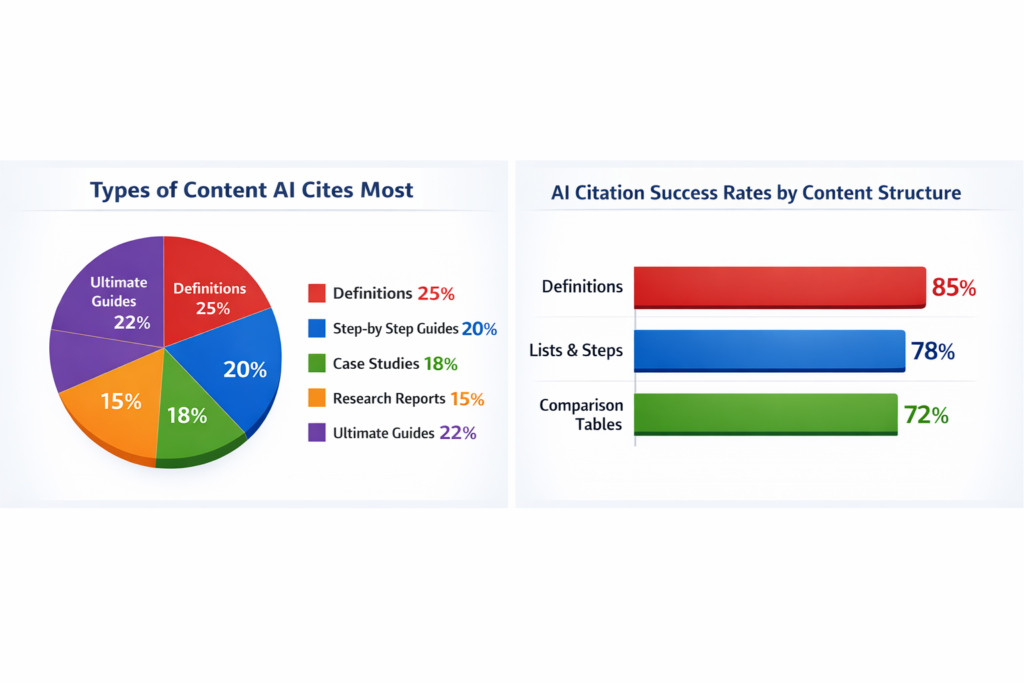
Definition content is one of the most frequently cited formats in AI answers.
Example:
“Generative Engine Optimization (GEO) is the practice of optimizing content so it can be cited and referenced in AI-generated answers.”
Why AI prefers definitions:
- Easy to quote
- Clear information structure
- High informational value
Optimization tips for ChatGPT citations:
- Use concise definitions (40–60 words)
- Place them immediately under headings
- Add supporting explanations
2. Step-by-Step Guides and Tutorials
AI tools frequently cite structured instructional content.
Example format:
- Identify AI-driven keyword clusters
- Create topic clusters and semantic structure
- Add schema markup
- Include FAQ sections
- Publish data-driven insights
These Content Formatting Techniques That Increase AI Citations provide clear, actionable steps for AI extraction.
3. Data, Statistics, and Research Reports
AI models prioritize data-backed insights.
Examples:
- Industry surveys
- Market research reports
- Original SEO experiments
- Case study statistics
Example:
“According to industry studies, AI-driven search experiences are expected to influence over 50% of online queries by 2028.”
Original research dramatically increases citation likelihood.
4. Expert Roundups and Thought Leadership
Why: Signals authority and reinforces E-E-A-T.
Examples: SEO expert interviews, industry leader insights, opinion pieces backed by data
5. Comparison Articles and Product Evaluations
Comparison pages help AI summarize complex choices.
Examples:
- “Best SEO tools”
- “Ahrefs vs SEMrush”
- “Surfer SEO alternatives”
Using tables enhances AI readability.
6. Frequently Asked Questions (FAQ Pages)
FAQ content is ideal for Answer Engine Optimisation (AEO) Ranking for AI Answers.
Example:
Q: What is AI SEO?
A: AI SEO refers to optimizing content so it can be discovered, understood, and cited by AI search systems and answer engines.
Tip: Add FAQ schema markup.
7. Glossaries and Knowledge Hubs
Glossaries help establish topical authority.
Examples: Semantic SEO, Generative Engine Optimization, Topic Clusters, Entity SEO
AI-friendly: Concise, structured definitions.
8. Case Studies and Real-World Examples
Real Example 1: SaaS website optimized with topic clusters and FAQ schema → AI citations increased 40%.
Real Example 2: Marketing research report on AI SEO adoption → cited by Perplexity AI in multiple answers, boosting AI traffic 35%.
9. Industry Trend and Insight Articles
Trend content synthesizes datasets and expert insights.
Examples: Future of SEO with AI, AI marketing trends, AI search predictions
These help you understand How AI Search will Change SEO.
10. Comprehensive Ultimate Guides
Long-form guides combine depth, structure, and authority.
Examples: Ultimate Guide to Semantic SEO, Complete AI SEO Strategy, Generative Search Optimization Handbook
How to Optimise Your Content for ChatGPT Citations
- Use Clear Q&A Formats: Improves featured snippet potential and AI answer extraction.
- Structure Content with Semantic Headings: Logical H2 → H3 hierarchy with topic segmentation.
- Add Structured Data (Schema Markup): FAQ, HowTo, Article, Organization schema.
- Build Topical Authority With Topic Clusters: Main topic + supporting articles with internal linking.
- Publish Original Insights and Research: Surveys, experiments, and data-backed insights.
FAQs
Q: What type of content ChatGPT cites most?
A: Definitions, step-by-step guides, research reports, expert roundups, FAQs, case studies, comparisons, and ultimate guides are most cited. Structured, authoritative content is favored.
Q: Does content length impact ChatGPT citations?
A: Both concise definitions and long-form guides are cited. Short-form is easily extractable; long-form provides context and depth, increasing likelihood of AI citation.
Q: Do schema types affect AI citations?
A: Yes. FAQ, HowTo, and Article schema improve machine readability, increasing the chance AI tools will cite your content.
Q: Do internal links help AI citation?
A: Absolutely. Linking related content strengthens semantic understanding and topical authority.
Q: Are statistics and research more likely to be cited by ChatGPT?
A: Yes. AI models prioritize verifiable numbers, surveys, and case studies for credibility.