Advanced SEO Strategies to Drive Modern Business Growth
What Is an Advanced SEO Strategy?
Advanced SEO Strategy in today’s digital landscape is no longer optional, it is essential, as business growth is closely tied to search visibility.
Achieving strong rankings now goes far beyond basic optimisation; it demands a strategic, data-driven approach that blends technical performance, authoritative content, and AI-powered insights.
This guide delves into advanced SEO techniques. It covers strategic keyword planning and content clustering. It also includes Generative Engine Optimisation (GEO) and voice search.
These are designed to boost visibility. They attract targeted traffic and drive measurable business growth.
These strategies are built for modern search. They reflect how algorithms, AI systems, and user behaviour continue to evolve. This gives you the framework needed to stay competitive.
By the end, you’ll know how to build a future-proof SEO strategy. You will avoid costly mistakes. You will leverage the latest tools and innovations to turn your website into a scalable growth engine.
Key Takeaways:
- How to build an advanced SEO strategy that drives traffic, rankings, and conversions
- How to leverage keyword research, search intent, and semantic SEO effectively
- How to create content that establishes topical authority and strong E-E-A-T signals
- How to optimise technical SEO foundations, including site speed, schema, and crawlability
- How to apply AI and GEO techniques for next-generation search visibility
- How to avoid common SEO mistakes that limit performance or cause penalties
- How to measure SEO performance and ROI using data-driven insights
- Key future trends, including voice search, AI-generated content, and zero-click results
This article outlines how to build a high-impact SEO strategy using keyword research, semantic optimisation, content authority, technical SEO, and AI-driven techniques , while preparing for the future of search.
Get Your Free SEO Audit
Enter your website URL and email below to receive a free audit highlighting your top SEO opportunities.
What is advanced SEO strategy
An advanced SEO strategy is a comprehensive, data-driven approach designed to improve a business’s online visibility, drive targeted traffic, and establish long-term topical authority.
It combines technical SEO, content strategy, authority building, and analytics to create a scalable system for sustainable growth. Unlike basic SEO, it prioritises semantic relevance, user intent, and AI search alignment.
Key Components:
- Technical SEO: Crawlability, indexing, site speed, Core Web Vitals, structured data.
- Content Strategy: Pillar pages, content clusters, long-tail keywords, semantic SEO.
- Authority Building: Backlinks, digital PR, brand mentions, entity relevance.
- Data & Analytics: KPI tracking, performance analysis, continuous optimisation loops.
Example: A small business may focus on local SEO, blog content, and foundational link building, while an enterprise-level company integrates global keyword strategy, content clusters, schema markup, and AI search optimisation for GEO inclusion.
Why Traditional SEO Is No Longer Enough for Modern Businesses
Traditional SEO strategies, such as keyword stuffing or single-page optimisation, no longer deliver competitive results. Modern search engines prioritise semantic relevance, user intent, and authority signals.
Additionally, AI-driven search results and generative answer engines now favour topically rich content that demonstrates expertise, experience, authority, and trust (E-E-A-T).
Key Points:
- Outdated techniques: Keyword stuffing, low-quality backlinks, thin content.
- Modern SEO requirements: Semantic content, entity-based optimisation, structured answers.
- Impact: Businesses relying solely on basic SEO often plateau in rankings, while advanced strategies enable consistent traffic growth and SERP dominance.
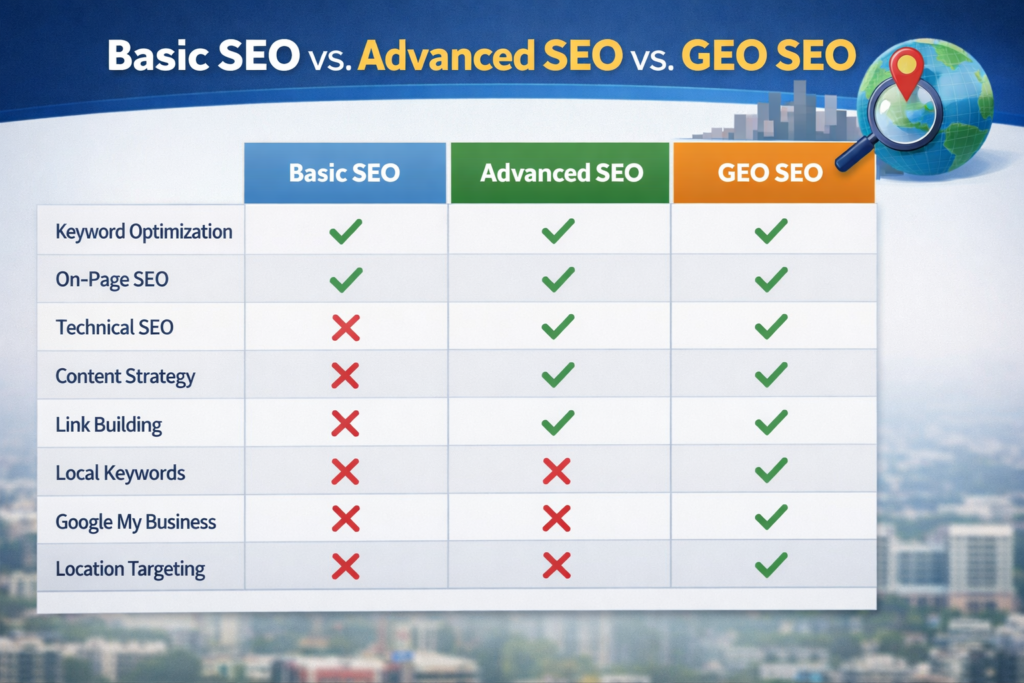
SEO vs GEO (Generative Engine Optimization)
While Search Engine Optimisation SEO focuses on ranking pages in traditional search engines like Google, Generative Engine Optimization (GEO) targets inclusion in AI-generated answers on platforms like ChatGPT, Perplexity, or Bing Copilot.
GEO emphasises entities, structured content, and conversational queries rather than only keywords.
Key Points:
- SEO: Keyword-driven, SERP-focused, backlinks and technical optimisation.
- GEO: Entity-driven, AI-friendly formatting, FAQs, structured and concise answers.
- Implementation: Optimise content for both human readers and AI answer engines, including bullet lists, short paragraphs, and clear headings.
Example: A Google SERP may show a website ranking for “advanced SEO strategy,” while an AI engine could directly answer “What is an advanced SEO strategy?” by pulling structured, entity-rich content from your site.
Setting Business Goals and KPIs
Before you dive into keywords, content, or technical optimisations, the foundation of any advanced SEO strategy is defining clear business goals and measurable KPIs.
Without this, it’s impossible to determine whether your SEO efforts are delivering real value to your business.
Types of KPIs to Track:
- Organic Traffic: Monitor sessions, unique visitors, and growth trends to see if your SEO is driving more people to your site.
- Ranking Positions: Track target keywords to measure visibility and SERP performance.
- Conversions: Measure leads, sales, newsletter signups, or other actions aligned with business objectives.
- Backlinks: Evaluate both quantity and quality of inbound links to gauge authority.
- Engagement Metrics: Look at bounce rate, session duration, and pages per session to understand user experience.
Aligning SEO KPIs with Business Objectives:
Every KPI should map directly to your broader business goals, whether that’s increasing revenue, boosting brand awareness, or generating more qualified leads.
This ensures that SEO is not just about rankings, but about driving measurable business growth.
Examples:
- Small Business: A local cafe may aim to increase local organic leads by 30% within six months by optimising for location-based keywords and building local citations.
- Enterprise: A global SaaS company might focus on growing organic traffic across multiple product lines, improving keyword rankings in several regions, and increasing overall domain authority.
Visual Frameworks to Consider:
- SMART Goals: Specific, Measurable, Achievable, Relevant, and Time-bound goals help define clear objectives.
- KPI Dashboards: Visual dashboards can track organic traffic trends, conversions, backlinks, and engagement metrics in real-time, making it easier to monitor progress and adjust strategy.
To build an effective SEO strategy, start by defining measurable business goals and KPIs, such as organic traffic growth, conversion rates, and authority signals, ensuring alignment with overall business objectives.
Market and Competitor Analysis
Understanding your market and competitors is critical to building an advanced SEO strategy.
Knowing what others in your niche are ranking for, how they structure content, and where they acquire backlinks allows you to identify gaps, opportunities, and differentiation points for your own strategy.
Steps to Conduct Market and Competitor Analysis:
- Identify Top Competitors
- Local Businesses: Identify nearby competitors if you rely on geographic search (e.g., a local café or boutique).
- National Competitors: Recognise broader players in your industry targeting your same audience.
- Global Competitors: For enterprise-level businesses or products with international reach, map global competition across regions and languages.
- Analyse Keywords and Content Strategy
- Identify which keywords your competitors rank for and their search volumes.
- Examine their content topics, formats, and depth to see what works and what doesn’t.
- Spot content gaps where you can create more valuable, comprehensive, or updated content.
- Evaluate Backlink Profiles and Authority
- Check competitors’ backlink sources, domain authority, and link velocity.
- Identify link opportunities and partnerships to improve your own authority.
- Assess Technical SEO Setup
- Examine site structure, speed, mobile experience, and schema markup.
- Look for technical weaknesses in competitors’ sites that you can outperform.
Tools to Use:
- Ahrefs & SEMrush: Keyword research, competitor backlink analysis, ranking tracking.
- Surfer SEO: Content gap and SERP analysis.
- Google Search Console: Benchmark your site performance and compare against competitors indirectly.
Real-World Examples:
- Small Brand: A boutique e-commerce store may analyse three local competitors, focus on high-intent long-tail keywords, and identify content gaps in local product guides.
- Enterprise: A global SaaS company evaluates dozens of international competitors, maps keyword clusters across multiple markets, and identifies link-building opportunities from high-authority industry sites.
Conducting SEO competitor analysis allows businesses to uncover keyword gaps, evaluate content strategies, and identify backlink opportunities, ensuring your SEO strategy is informed, competitive, and aligned with market trends.
Building a Scalable SEO Roadmap
A well-structured SEO roadmap ensures that your strategy is organized, measurable, and scalable over time.
It helps businesses systematically address technical issues, create high-impact content, build authority, and continuously optimise for growth—without losing focus or resources.
Structuring Your SEO Roadmap:
Phase 1: Technical Audit and Fixes
- Conduct a full site audit to identify crawlability issues, broken links, site speed problems, and mobile optimisation gaps.
- Prioritise fixes based on impact and severity, ensuring your website is technically sound before investing heavily in content.
Phase 2: Content Creation and Optimisation
- Develop pillar pages and content clusters aligned with keyword strategy and search intent.
- Optimise existing content for semantic SEO, readability, and AI search relevance.
- Ensure content addresses user needs at every stage of the buyer journey.
Phase 3: Authority Building
- Focus on backlinks, digital PR, guest posts, and partnerships to boost domain authority.
- Track competitor backlink profiles to identify opportunities for high-value link acquisition.
- Maintain white-hat practices to build sustainable authority.
Phase 4: Continuous Monitoring and Optimisation
- Set up tracking dashboards for traffic, rankings, conversions, and engagement.
- Implement an iterative optimisation process: identify underperforming content, update, and improve over time.
- Use data-driven decisions to prioritise new campaigns or updates.
Prioritisation Framework:
- Balance ROI vs effort: focus first on high-impact, low-effort tasks.
- Consider short-term vs long-term wins: quick fixes vs strategies that build lasting authority and growth.
Visual Example:
- A Gantt chart or phased roadmap can illustrate the timeline of SEO implementation across these four phases.
- Scalability should be considered:
- Small Businesses: Focus on local SEO, high-impact keywords, and quick-win content optimisations.
- Enterprise: Coordinate multi-team projects, international markets, and large-scale content and authority campaigns.
A scalable SEO roadmap structures strategy into phases, technical audit, content creation, authority building, and continuous optimisation, ensuring businesses of any size can achieve sustainable growth while prioritising high-impact tasks and measurable results.
Content Strategy for Topical Authority & E-E-A-T
Pillar Pages and Content Clusters
Pillar pages act as comprehensive guides that cover a broad topic in depth, serving as the central hub for your content strategy.
Supporting content clusters are individual articles that dive into subtopics and link back to the pillar page.
This structure improves semantic relevance, internal linking, and crawlability, helping search engines understand your site as a topic authority.
Examples:
- Pillar Page: “Advanced SEO Strategy”
- Content Clusters: Technical SEO, GEO optimisation, Keyword Research, Content Marketing
Internal Linking Structure:
- Each cluster should link back to the pillar page and to other relevant clusters, forming a web of related content that strengthens topical authority.
Pillar pages act as comprehensive guides, supported by content clusters on subtopics, building topical authority and improving SEO performance.
Building Topical Authority in Your Niche
Topical authority is achieved when your site is recognised as an expert on a subject by both search engines and users.
Strategies include publishing comprehensive content, maintaining consistent publishing schedules, and referencing expert sources. Semantic signals such as internal links, entity mentions, and structured data reinforce authority.
Examples:
- Small Business: Focus on a few niche topics, producing highly detailed posts that answer every relevant question.
- Enterprise: Cover a broader range of topics at scale, maintaining deep coverage across multiple subtopics.
Topical authority is established by publishing comprehensive, semantically-rich content across a topic, signalling expertise and trust to search engines and users.
Content Depth vs Content Velocity
There is a trade-off between content depth and publishing frequency. Long, high-quality pillar posts provide more authority signals and often outperform frequent, smaller posts. Align content strategy with E-E-A-T principles, prioritising quality over sheer quantity.
Examples:
- Enterprise: Fewer, deeply-researched pillar posts with detailed data and analysis.
- Small Business: Regular blog posts that thoroughly explore niche topics without sacrificing depth.
Impact: Deep, high-quality content improves rankings, engagement, and overall topical authority.
High-quality, in-depth content consistently outranks frequent low-value posts, enhancing topical authority and E-E-A-T signals for better SEO performance.
Optimising for Expertise, Experience, Authority, Trust
E-E-A-T is a cornerstone of modern SEO:
- Expertise: Author credentials, knowledge, and professional authority.
- Experience: Real-world examples, case studies, and hands-on insights.
- Authority: Backlinks, citations, brand mentions, and recognition within your niche.
- Trust: Accurate information, transparency, and excellent UX signals.
Practical Examples:
- Author bios with credentials and linked references
- Structured content and schema markup to highlight entities and AI relevance
- Case studies or real-world examples to demonstrate experience
AI/GEO Relevance: Structured content and entity mentions improve AI answer inclusion and generative search visibility.
Optimising for E-E-A-T involves demonstrating expertise, sharing real-world experience, building authority through backlinks, and ensuring trust through accurate, transparent content.
Internal Linking Suggestions:
- “Advanced Keyword Research & Search Intent Mapping”
- “Technical SEO Foundations for High Performance”
- “AI SEO & Generative Engine Optimization”
- “Link Building & Authority Growth Strategies”
Technical SEO Foundations for High Performance
Core Web Vitals and Page Experience
Core Web Vitals measure loading performance, interactivity, and visual stability of a website. Optimising these signals improves user experience and is a direct ranking factor for Google. Focus on:
- Largest Contentful Paint (LCP): Measures loading speed of main content.
- First Input Delay (FID): Measures interactivity responsiveness.
- Cumulative Layout Shift (CLS): Measures visual stability during loading.
Examples:
- Compressing images and implementing lazy loading improves LCP.
- Reducing render-blocking scripts enhances FID.
- Properly sizing media and fonts prevents CLS issues.
Optimising Core Web Vitals improves page experience by enhancing speed, responsiveness, and visual stability, which directly impacts search rankings and user engagement.
Crawlability, Indexing, and Site Architecture
Ensure search engines can discover and index your content efficiently. Steps include:
- Designing a logical site structure with clear hierarchy (homepage → category → subcategory → page).
- Using XML sitemaps and robots.txt files to guide crawlers.
- Implementing canonical tags to prevent duplicate content issues.
- Monitoring crawl errors via Google Search Console.
Examples:
- A blog with topic clusters should link all supporting posts back to the pillar page for maximum crawl efficiency.
- Enterprises should maintain multi-language sitemaps for international indexing.
Optimising site architecture ensures search engines can crawl and index your pages efficiently, improving visibility, rankings, and overall SEO performance.
Schema Markup and Structured Data
Structured data helps search engines understand the context of your content, increasing eligibility for rich results and AI-driven answer features.
- Apply schema types relevant to your business: Article, Product, Local Business, FAQ, How-To.
- Use JSON-LD format for easier implementation and maintenance.
- Highlight entities and relationships to improve semantic SEO and AI search inclusion.
Examples:
- FAQ schema can increase chances of appearing in People Also Ask boxes.
- Product schema improves e-commerce visibility in search results with ratings, price, and availability.
Implementing schema markup and structured data helps search engines understand your content, enabling rich snippets and enhancing visibility in AI-driven search features.
Mobile-First and International SEO
With the majority of searches on mobile devices, Google uses mobile-first indexing:
- Ensure your site is fully responsive and loads quickly on all devices.
- Optimise touch elements, font sizes, and media queries for mobile UX.
For global businesses, international SEO includes:
- Using hreflang tags for multi-language versions.
- Structuring content for regional relevance.
- Monitoring country-specific SERPs and user behaviour.
Mobile-first and international SEO ensure websites provide excellent user experience on all devices and are optimised for regional search visibility, driving global growth.
Internal Linking Suggestions:
- “Advanced Keyword Research & Search Intent Mapping”
- “Content Strategy for Topical Authority & E-E-A-T”
- “AI SEO & Generative Engine Optimization”
- “Measuring SEO Performance & ROI”
Internal Linking Suggestions
- “Advanced Keyword Research & Search Intent Mapping”
- “Content Strategy for Topical Authority & E-E-A-T”
- “Measuring SEO Performance & ROI”
- “AI SEO & Generative Engine Optimization”
Link Building & Authority Growth Strategies
White-Hat vs Black-Hat Link Building
Definition & Key Points:
- White-Hat SEO: Ethical, Google-compliant link building that grows authority sustainably. Focuses on high-quality, contextually relevant backlinks from authoritative sources.
- Black-Hat SEO: Manipulative tactics, including link farms, spammy directories, and PBNs (Private Blog Networks), aiming for short-term ranking gains but with high penalty risk.
Comparison Table:
| Technique | Risk | Benefit |
|---|---|---|
| White-hat | Low | Long-term authority & trust |
| Black-hat | High | Short-term rankings, potential penalties |
Examples:
- Small Business: Guest blog posts on local industry sites, partnerships with niche influencers.
- Enterprise: Backlinks from high-authority publications, industry research citations, whitepapers, and global media coverage.
High-quality, contextually relevant backlinks signal topical authority to AI answer engines and generative search, improving AI-driven content visibility.
White-hat link building focuses on ethical, high-quality backlinks that improve long-term authority, while black-hat tactics risk penalties and short-term gains.
Digital PR and Brand Mentions
Definition & Key Points:
- Digital PR leverages media coverage, press releases, and strategic collaborations to earn backlinks and improve overall SEO authority.
- Types of mentions include:
- Editorial links: Articles on authoritative sites linking to your content
- Brand citations: Mentions without direct links that reinforce entity authority
- Influencer mentions: Social or blog coverage that drives both traffic and credibility
Implementation Examples:
- Enterprise: Publish industry research, white papers, or thought leadership pieces cited by top-tier media outlets.
- Small Business: Guest posts on niche blogs, local press coverage, or collaborations with industry influencers.
Brand mentions strengthen entity recognition, helping AI search engines and generative models understand your brand as an authoritative source.
Digital PR leverages brand mentions, press coverage, and collaborations to build backlinks and enhance SEO authority.
Outreach and Relationship-Based Backlinks
Definition & Key Points:
- Relationship-based outreach involves proactively contacting relevant industry websites to acquire high-quality backlinks.
- Methods include:
- Personalised outreach emails
- Guest posts on relevant blogs
- Co-authored content or collaborative resources
- Best Practices:
- Focus on relevance and value-first approach
- Maintain persistent, professional follow-ups
- Track outreach effectiveness using CRM or SEO tools
Examples:
- Small Business: Connect with niche bloggers to review products or feature your services.
- Enterprise: Build partnerships with authoritative industry sites, syndicate research content, or co-create resources.
Relationship-based backlinks boost entity authority signals, improving inclusion in AI-driven search results and generative answer features.
Relationship-based outreach builds high-quality backlinks by connecting with relevant websites, improving authority and search engine trust signals.
Internal Linking Optimisation
Definition & Key Points:
- Internal linking improves site crawlability, distributes link equity, and reinforces topical authority across content clusters.
- Techniques include:
- Linking blog posts to pillar pages and content clusters
- Using descriptive anchor text aligned with target keywords
- Creating logical site hierarchies (siloing) for thematic clarity
Examples:
- Link “Keyword Research & Intent Mapping” post to the “Advanced SEO Strategy” pillar page.
- Link technical SEO articles to performance optimisation guides to maintain semantic flow.
Structured internal links help AI and generative engines understand entity relationships and topical hierarchy.
Optimised internal linking improves site crawlability, distributes link equity, and reinforces topical authority across content clusters.
Internal Linking Suggestions
- “Content Strategy for Topical Authority & E-E-A-T”
- “Technical SEO Foundations for High Performance”
- “AI SEO & Generative Engine Optimization”
- “Measuring SEO Performance & ROI”
AI SEO & Generative Engine Optimization (GEO)
How AI Search Engines Rank Content
Content Guidance / Key Points:
- Definition: AI search engines (ChatGPT, Perplexity, Gemini, Bing Copilot) evaluate content based on relevance, semantic coverage, and authority.
- Key Ranking Factors:
- Topical depth and semantic entities
- Structured content and schema
- Authoritativeness and trust signals (E-E-A-T)
- User intent alignment and query satisfaction
- Example: Enterprise blog targeting “AI SEO strategies” with detailed clusters, structured headings, and citations
- Snippet Opportunity:
“AI search engines rank content by assessing relevance, semantic depth, structured data, and authority signals, ensuring users get precise, trustworthy answers.”
Optimising for Conversational Queries
Content Guidance / Key Points:
- Definition: Optimising content for natural language questions and voice search queries
- Techniques:
- Use question-based H2/H3 headings (FAQ format)
- Include concise, informative answers (40–60 words)
- Implement structured data like FAQ schema
- Example: Queries like “How do AI search engines rank content?” are answered directly in structured FAQ sections
- AI/GEO Note: Direct answers increase likelihood of appearing in AI-generated responses
Optimising for conversational queries ensures your content can be directly used in AI answers and voice search results.
Structuring Content for AI Answers
Content Guidance / Key Points:
- Principles: clear headings, semantic clusters, entity mentions, structured lists
- Benefits: improves AI comprehension and snippet inclusion
- Example: Pillar pages with supporting cluster articles, interlinked and annotated with schema
- AI/GEO Note: Entity-rich content increases visibility in AI-powered search engines
Structured, entity-rich content allows AI search engines to understand and present your content accurately in generated answers.
Entity-Based SEO and Knowledge Graphs
Content Guidance / Key Points:
- Definition: Entity-based SEO links content to concepts, people, brands, and locations for semantic relevance
- Implementation:
- Use consistent entity mentions in text
- Link to authoritative sources and internal pages
- Apply structured data to reinforce entity relationships
- Example: Optimising “Advanced SEO Strategy” page with entities: Google, SEO tools, AI models, GEO concepts
- AI/GEO Note: Knowledge graph alignment improves AI answer visibility and accuracy
Entity-based SEO connects content to concepts, brands, and locations, enhancing AI comprehension and ranking in generative search engines.
Internal Linking Suggestions:
- “Content Strategy for Topical Authority & E-E-A-T”
- “Advanced Keyword Research & Search Intent Mapping”
- “Technical SEO Foundations for High Performance”
- “Link Building & Authority Growth Strategies”
SEO Tools & Automation for Scaling Growth
Keywords: SEO tools, SEO automation, AI-powered SEO, technical SEO software
Intent: Informational / Commercial (Snippet Opportunity)
Keyword Research Tools
Keyword research tools are essential for discovering high-volume, low-competition, and long-tail keywords that align with user search intent.
These tools help businesses identify opportunities to rank, build content strategies, and target the right audience at every stage of the buyer journey.
Popular Tools:
- Ahrefs
- SEMrush
- Google Keyword Planner
- Ubersuggest
Best Practices:
- Cluster keywords by topic and search intent to build structured content
- Focus on long-tail keywords for higher conversion rates and lower competition
- Identify semantic variations to improve AI/GEO optimisation
Example:
- Small Business: Uses Google Keyword Planner to target local search terms like “SEO consultant near me”
- Enterprise: Uses Ahrefs to build large-scale keyword clusters across multiple markets and topics
Keyword research tools help identify high-volume, low-competition keywords and organise them by topic and intent for SEO growth.
Technical SEO Audit Tools
Technical SEO audit tools scan your website to identify issues that may impact search engine rankings, crawlability, and overall performance. Regular audits ensure your site remains optimised and competitive.
Popular Tools:
- Screaming Frog
- Sitebulb
- SEMrush Site Audit
- Google Search Console
Key Checks:
- Crawl errors, broken links, and redirects
- Indexability and XML sitemap validation
- Core Web Vitals and page performance metrics
Example:
- Small Business: Uses Google Search Console to monitor indexing issues and fix errors
- Enterprise: Conducts monthly audits using Screaming Frog or SEMrush across large websites
Technical SEO audit tools detect crawl errors, indexability issues, and performance problems to maintain website health and rankings.
AI-Powered Content Tools
AI-powered tools assist with content research, creation, and optimisation, enabling businesses to scale their SEO efforts efficiently while maintaining relevance and quality.
Popular Tools:
- ChatGPT
- Perplexity AI
- Surfer SEO
- Clearscope
- Frase
Best Practices:
- Generate content outlines based on keyword clusters and semantic relevance
- Optimise content for E-E-A-T and topical authority
- Maintain human oversight to ensure accuracy, originality, and trustworthiness
Example:
- Small Business: Uses ChatGPT to generate blog ideas and outlines
- Enterprise: Combines Surfer SEO with AI tools to scale high-quality content production
AI-powered content tools help create and optimise content at scale, improving topical authority and search performance.
Automation Workflows for SEO
SEO automation involves using tools and systems to streamline repetitive tasks, allowing teams to focus on strategy and growth.
Examples of Automation:
- Scheduling content publishing across blogs and CMS platforms
- Automating internal linking suggestions
- Generating SEO performance reports and dashboards
Benefits:
- Saves time and reduces manual effort
- Minimises errors and improves consistency
- Enables scaling across multiple websites or campaigns
AI/GEO Note: Automation ensures a consistent flow of entity-rich, optimised content, improving visibility in AI-driven and generative search engines.
SEO automation workflows streamline repetitive tasks like publishing, internal linking, and reporting, allowing teams to scale efficiently.
Measuring SEO Performance & ROI
Key SEO Metrics and KPIs
SEO metrics and KPIs are used to evaluate the effectiveness of your SEO strategy and its impact on business outcomes.
Tracking the right data ensures you can measure growth, identify weaknesses, and optimise performance over time.
Important Metrics:
- Organic Traffic Growth: Measures increases in visitors from search engines
- Keyword Rankings: Tracks visibility for both short-tail and long-tail keywords
- Domain Authority & Backlink Quality: Indicates site credibility and trust
- Engagement Metrics: CTR, bounce rate, and time on page reveal user behaviour
Example:
- Small Business: Focuses on top-performing local keywords and traffic trends
- Enterprise: Monitors thousands of keywords, backlink profiles, and referral traffic across multiple regions
Key SEO metrics include organic traffic, keyword rankings, backlink quality, and user engagement, providing insights into search performance and ROI.
Tracking Rankings and Traffic
Tracking rankings and traffic involves monitoring how your pages perform in search engines over time. This helps identify which strategies are working and where improvements are needed.
Tools:
- Google Search Console
- Ahrefs
- SEMrush
- Rank tracking tools
Best Practices:
- Track keyword positions on a weekly or monthly basis
- Analyse traffic sources and top-performing landing pages
- Compare historical data to identify trends and growth opportunities
Example:
A blog post targeting “advanced SEO strategy” may initially rank on page one but outside the top three. By tracking its performance and optimising content, it can gradually move into higher-ranking positions.
Tracking SEO rankings and organic traffic helps identify top-performing content and opportunities for optimisation.
Conversion Tracking and Attribution
Conversion tracking connects SEO performance to real business outcomes, allowing you to measure the true ROI of your efforts.
Techniques:
- Set up goals in Google Analytics or GA4
- Track actions such as:
- Form submissions
- E-commerce purchases
- Newsletter sign-ups
- Attribute conversions to organic search vs other channels
Example:
- Small Business: Tracks local leads generated from organic search and Google Maps
- Enterprise: Uses multi-channel attribution models to measure how organic search contributes to conversions across touchpoints
Conversion tracking connects SEO efforts to tangible business outcomes, helping calculate true ROI from organic search.
Continuous Optimization Loop
SEO is not a one-time effort, it requires a continuous optimisation loop to maintain and improve performance.
Steps:
- Conduct regular content and technical audits
- Update keyword targeting based on search trends and user behaviour
- Refresh underperforming pages with improved content and structure
- Incorporate insights from AI/GEO analytics and search data
Example:
- Small Business: Updates blog posts monthly to keep content relevant
- Enterprise: Runs quarterly audits and continuous A/B testing across large-scale SEO campaigns
Snippet Opportunity:
“A continuous optimization loop ensures SEO performance improves over time by regularly auditing, updating, and refining strategies.”
Optimisation Layer
- Primary Keyword: SEO performance & ROI
- Secondary Keywords: SEO metrics, tracking rankings, conversion attribution, continuous SEO optimisation
- Search Intent: Informational / Commercial
- Semantic Coverage: analytics, KPIs, organic traffic, conversion tracking, iterative optimisation, AI/GEO monitoring, SERP features
Internal Linking Suggestions
- “Advanced Keyword Research & Search Intent Mapping”
- “Content Strategy for Topical Authority & E-E-A-T”
- “Technical SEO Foundations for High Performance”
- “AI SEO & Generative Engine Optimization
SEO Strategies by Business Type
Small Business SEO Strategy
Small business SEO focuses on tailored, cost-effective strategies designed to increase visibility in local search results and attract nearby customers.
Unlike enterprise SEO, the emphasis is on targeted reach and quick wins rather than large-scale campaigns.
Key Techniques:
- Optimise local SEO signals, including Google Business Profile and customer reviews
- Target long-tail and geo-specific keywords with clear purchase intent
- Focus on affordable content marketing and link building, such as local partnerships and guest posts
Example:
A local bakery improves visibility by optimising its Google Business Profile and publishing blog content targeting phrases like “gluten-free bakery in [city],” driving both search traffic and in-store visits.
Small business SEO focuses on local search optimisation, targeted long-tail keywords, and cost-effective strategies to attract nearby customers.
eCommerce SEO Strategy
eCommerce SEO is focused on improving product visibility, user experience, and conversions for online stores. It combines technical optimisation with content and keyword targeting to drive transactional traffic.
Key Techniques:
- Optimise product titles, descriptions, and images with relevant keywords
- Implement structured data (product schema) for enhanced search visibility
- Strengthen category pages and internal linking to improve navigation and authority
- Target transactional and commercial intent keywords
Example:
An online clothing store optimises product pages for “sustainable cotton t-shirts” while linking from blog content to product and category pages, increasing both rankings and conversions.
Snippet Opportunity:
“eCommerce SEO improves product visibility through optimised titles, descriptions, category pages, and structured data for higher conversions.”
B2B and SaaS SEO Strategy
B2B and SaaS SEO strategies focus on attracting decision-makers through high-value content, authority building, and long sales cycle optimisation. The goal is to generate qualified leads rather than just traffic.
Key Techniques:
- Create long-form, in-depth content addressing industry challenges and solutions
- Build pillar pages and content clusters to demonstrate topical authority
- Acquire backlinks from industry publications, LinkedIn, and authoritative sources
Example:
A SaaS company publishes a comprehensive “2026 Guide to AI SEO,” targeting enterprise marketers and decision-makers, driving high-quality leads through organic search.
B2B and SaaS SEO focuses on long-form authority content, pillar pages, and industry backlinks to attract decision-makers and drive leads.
Startup SEO Roadmap
Startup SEO is designed to help new businesses gain traction quickly and establish an online presence with limited resources. The focus is on building a strong foundation while scaling strategically.
Key Techniques:
- Implement foundational technical SEO from the start
- Target high-opportunity niche keywords with lower competition
- Build scalable content clusters for long-term growth
- Set up analytics early to track SEO KPIs and performance
Example:
A SaaS startup launches with blog and tutorial content targeting keywords like “how to optimise SEO for small SaaS,” helping build early authority and attract initial users.
Startup SEO focuses on foundational SEO, niche keyword targeting, and scalable content to quickly build online visibility.
Optimisation Layer
- Primary Keyword: SEO strategies by business type
- Secondary Keywords: small business SEO, eCommerce SEO, B2B SEO, SaaS SEO, startup SEO roadmap
- Search Intent: Informational / Commercial
- Semantic Coverage: local search, eCommerce visibility, enterprise SEO, SaaS marketing, startup growth, keyword targeting, pillar pages
Internal Linking Suggestions
- “Local SEO Strategy for Business Visibility”
- “Advanced Keyword Research & Search Intent Mapping”
- “Content Strategy for Topical Authority & E-E-A-T”
- “Technical SEO Foundations for High Performance”
- “Link Building & Authority Growth Strategies”
Common SEO Mistakes to Avoid
Keyword Stuffing and Outdated Tactics
Keyword stuffing and outdated SEO tactics are among the most common mistakes that can negatively impact rankings and credibility.
Keyword stuffing involves overusing target keywords unnaturally in content, while outdated tactics rely on manipulative techniques that no longer align with modern search engine algorithms.
Examples of Mistakes:
- Repeating the same keyword excessively in headings and paragraphs
- Using hidden text, doorway pages, or spammy link schemes
- Relying on low-quality backlinks or automated content
Impact:
- Triggers search engine penalties
- Reduces trust and authority signals
- Leads to poor user experience and lower engagement
Best Practices:
- Use natural keyword placement within context
- Incorporate semantic variations and related terms
- Focus on user intent and content quality rather than keyword density
Avoid keyword stuffing and outdated SEO tactics, as they can harm rankings and trigger search engine penalties.
Ignoring Search Intent
Ignoring search intent occurs when content does not align with what users are actually looking for, resulting in poor engagement and ineffective SEO performance.
Examples of Mistakes:
- Creating informational content for queries with transactional intent
- Targeting high-volume keywords that are irrelevant to your audience
- Failing to match content format (e.g., blog vs product page) with user expectations
Impact:
- Higher bounce rates and lower dwell time
- Reduced relevance signals for search engines
- Lower rankings despite targeting popular keywords
Best Practices:
- Identify and map search intent (informational, commercial, transactional)
- Align content format and messaging with user expectations
- Continuously refine content based on performance data
Ignoring search intent leads to low engagement and poor SEO performance, as content must align with user queries.
Weak Content Structure
A weak content structure makes it difficult for both users and search engines to understand and navigate your content effectively. Clear structure is essential for readability, topical authority, and AI comprehension.
Examples of Mistakes:
- Long, unbroken paragraphs without subheadings
- Missing or inconsistent use of H1, H2, and H3 tags
- Lack of internal linking between related content
Impact:
- Reduced readability and user engagement
- Lower topical authority signals
- Poor interpretation by AI search engines and generative systems
Best Practices:
- Use a clear H2/H3 hierarchy to organise content logically
- Break content into scannable sections with bullet points
- Implement internal linking to connect related topics
Weak content structure makes it hard for readers and search engines to understand your article, reducing SEO effectiveness.
Technical SEO Neglect
Neglecting technical SEO can prevent even high-quality content from achieving strong rankings. Technical issues often limit crawlability, indexability, and overall performance, directly impacting visibility in search results.
Examples of Mistakes:
- Broken links and poor site speed
- Missing schema markup and structured data
- Crawl errors, indexation issues, and duplicate content
Impact:
- Search engines may fail to properly crawl or index pages
- Reduced rankings despite strong content
- Poor user experience affecting engagement and conversions
Best Practices:
- Conduct regular technical SEO audits
- Optimise page speed and Core Web Vitals
- Implement schema markup and structured data
- Fix crawl and indexing issues promptly
Neglecting technical SEO can prevent even high-quality content from ranking by causing crawl, indexation, or performance issues.
Optimisation Layer
- Primary Keyword: common SEO mistakes
- Secondary Keywords: keyword stuffing, search intent errors, weak content structure, technical SEO neglect
- Search Intent: Informational
- Semantic Coverage: content quality, search relevance, technical SEO, penalties, AI/GEO comprehension, user experience
Internal Linking Suggestions
- “Advanced Keyword Research & Search Intent Mapping”
- “Content Strategy for Topical Authority & E-E-A-T”
- “Technical SEO Foundations for High Performance”
- “Local SEO Strategy for Business Visibility”
- “SEO Performance & ROI Measurement”
Future Trends in SEO & AI Search
Voice and Conversational Search
Voice and conversational search are transforming how users interact with search engines, shifting from short keywords to natural, question-based queries.
Optimising for this trend requires content that mirrors how people speak and ask questions.
Key Techniques:
- Use natural language and long-tail keywords that reflect real conversations
- Structure content around question-based headings
- Provide clear, concise answers (40–60 words) for featured snippets and AI responses
- Implement FAQ schema to enhance structured data visibility
Example:
Optimising a blog post to answer queries like “How do AI search engines rank content?” increases the likelihood of appearing in voice search and AI-generated answers.
Voice and conversational search require content to answer natural, spoken questions directly and clearly for AI and voice assistants.
AI-Generated Content Impact
AI-generated content is rapidly scaling content production, but its effectiveness depends on quality, accuracy, and authority.
Search engines increasingly prioritise content that demonstrates E-E-A-T (Experience, Expertise, Authority, Trust).
Best Practices:
- Combine AI-generated drafts with human expertise and editorial oversight
- Optimise content for semantic relevance and topical authority
- Avoid publishing low-value, generic AI content that lacks depth or originality
Example:
A business uses AI tools to generate content outlines, then enhances them with expert insights, data, and case studies to produce high-ranking pages.
AI-generated content can enhance SEO at scale, but must maintain expertise, authority, and trust for ranking success.
Search Personalization and Zero-Click Searches
Search engines are increasingly delivering answers directly in the results page through featured snippets, knowledge panels, and AI-generated summaries, reducing the need for users to click through to websites.
Implications:
- Optimise content for featured snippets and AI answer boxes
- Structure content with concise, direct answers
- Use formatting like bullet points, tables, and short paragraphs
- Track zero-click performance metrics to measure visibility
Example:
Answering “What is an advanced SEO strategy?” in a clear 50-word definition increases the chances of appearing in a featured snippet or AI-generated result.
Zero-click and personalized search require optimising content for direct answers in SERP features and AI-driven results.
The Evolution of Generative Engine Optimization (GEO)
Generative Engine Optimization (GEO) represents the next evolution of SEO, focusing on how content is discovered and surfaced by AI-powered search engines and answer engines.
Key Strategies:
- Build entity-based content supported by structured data and knowledge graphs
- Optimise for conversational queries and natural language processing
- Strengthen semantic depth and topical authority through content clusters
- Ensure content is structured for AI readability and extraction
Example:
An enterprise website builds interconnected content clusters around core topics, making it easier for AI search engines to extract and present authoritative answers.
Generative Engine Optimization (GEO) evolves SEO for AI search engines by focusing on entities, conversational queries, and semantic authority.
Optimisation Layer
- Primary Keyword: future SEO trends
- Secondary Keywords: voice search, AI-generated content, zero-click search, personalized search, GEO SEO, generative search
- Search Intent: Informational / Authority
- Semantic Coverage: AI search evolution, conversational search, SERP features, AI content impact, knowledge graphs, semantic SEO
Internal Linking Suggestions
- “AI SEO & Generative Engine Optimization”
- “Advanced Keyword Research & Search Intent Mapping”
- “Content Strategy for Topical Authority & E-E-A-T”
- “Common SEO Mistakes to Avoid”
- “SEO Performance & ROI Measurement”
- Traditional SEO rankings
- Featured snippets & People Also Ask
- AI search engines & GEO visibility
Frequently Asked Questions About Advanced SEO Strategy
Questions (with snippet potential)
- What is an advanced SEO strategy? (Informational – Featured Snippet)
Snippet-ready: “An advanced SEO strategy combines technical SEO, content, authority building, and data-driven insights to improve visibility, rankings, and ROI for businesses of all sizes.” - How do businesses create an SEO strategy? (Informational)
Snippet-ready: “Businesses create an SEO strategy by defining goals, analysing competitors, performing keyword research, optimising content, and tracking performance metrics for continuous improvement.” - What are the key components of SEO strategy? (Snippet potential)
Answer: “Key components include technical SEO, keyword research, content strategy, link building, and performance measurement.” - How long does SEO take to show results? (High search volume)
Answer: “SEO typically shows measurable results within 3–6 months, depending on competition, website authority, and content quality.” - What is the difference between SEO and GEO? (Emerging trend snippet)
Answer: “SEO focuses on traditional search optimisation, while GEO (Generative Engine Optimization) targets AI-powered, conversational search engines using entity-based content and semantic authority.” - How do I find low competition keywords? (Snippet opportunity)
Answer: “Use keyword research tools to identify long-tail, high-intent, and low-competition keywords, then cluster them by topic and search intent.” - What is keyword clustering in SEO? (AI answer-friendly)
Answer: “Keyword clustering groups related keywords into thematic sets, improving content structure, relevance, and topical authority.” - How does search intent affect rankings? (Snippet potential)
Answer: “Content aligned with user search intent ranks higher because search engines prioritise relevance, engagement, and satisfaction.” - What is topical authority in SEO? (High-value query)
Answer: “Topical authority is the credibility and expertise a website demonstrates in a subject area through comprehensive, semantically-rich content.” - How do pillar pages improve SEO? (Snippet potential)
Answer: “Pillar pages organise content clusters around a central topic, improving crawlability, user experience, and authority for search engines.” - What are Core Web Vitals in SEO? (Snippet)
Answer: “Core Web Vitals are performance metrics that measure page speed, responsiveness, and visual stability to enhance user experience.” - How do I improve website speed for SEO? (Practical snippet)
Answer: “Optimise images, use caching, implement lazy loading, reduce code bloat, and leverage CDNs to improve website speed.” - What is schema markup and why is it important? (Featured Snippet)
Answer: “Schema markup adds structured data to webpages, helping search engines understand content and enhancing rich results in SERPs.” - How do backlinks improve SEO? (Core concept)
Answer: “Backlinks signal trust and authority to search engines, improving rankings and driving referral traffic.” - What is the best link building strategy? (Commercial intent)
Answer: “Focus on high-quality, relevant backlinks through outreach, digital PR, and relationship-based link acquisition.” - How does local SEO work? (Snippet opportunity)
Answer: “Local SEO optimises content, Google Business Profiles, and citations to rank for geographically relevant searches.” - How do I rank my business locally? (Commercial)
Answer: “Claim and optimise your Google Business Profile, encourage reviews, target local keywords, and maintain NAP consistency.” - What is Google Business Profile optimization? (Snippet)
Answer: “Optimising your Google Business Profile ensures accurate business information, photos, and reviews to improve local search visibility.” - What is AI SEO optimization? (Emerging topic)
Answer: “AI SEO optimisation uses AI tools to analyse, structure, and create content that aligns with semantic search, entity relevance, and user intent.” - How do AI search engines rank content? (High AI relevance)
Answer: “AI search engines rank content based on semantic relevance, entities, topical authority, user engagement, and context of queries.” - How do I optimize content for ChatGPT or AI tools? (GEO-focused)
Answer: “Structure content with clear entities, conversational queries, concise answers, and semantic relevance for AI retrieval and generative answers.” - What are the best SEO tools for businesses? (Commercial)
Answer: “Top tools include Google Search Console, Ahrefs, SEMrush, Screaming Frog, Surfer SEO, Clearscope, and AI content assistants.” - How do I track SEO performance? (Snippet potential)
Answer: “Monitor organic traffic, rankings, engagement, and conversions using analytics and SEO reporting tools.” - What metrics matter most in SEO? (Snippet)
Answer: “Important metrics include organic traffic, keyword rankings, backlinks, engagement, conversions, and ROI.” - What is a good SEO ROI? (Business-focused)
Answer: “A good SEO ROI depends on goals, but generally, a positive return from increased traffic, leads, and conversions indicates success.” - What are common SEO mistakes to avoid? (Snippet)
Answer: “Avoid keyword stuffing, ignoring search intent, weak content structure, and technical SEO neglect.” - How often should I update my SEO strategy? (Informational)
Answer: “Review and adjust your SEO strategy quarterly to stay aligned with algorithm updates and market trends.” - Is SEO still relevant in 2026? (Trend-based)
Answer: “Yes—SEO remains crucial, evolving with AI, voice search, and generative search engines to drive traffic and business growth.” - How does voice search affect SEO? (Future-focused)
Answer: “Voice search requires optimising for natural language, questions, and concise answers to capture conversational queries.” - What is zero-click search? (Snippet opportunity)
Answer: “Zero-click search occurs when users get answers directly in SERPs via featured snippets or knowledge panels without visiting a website.”